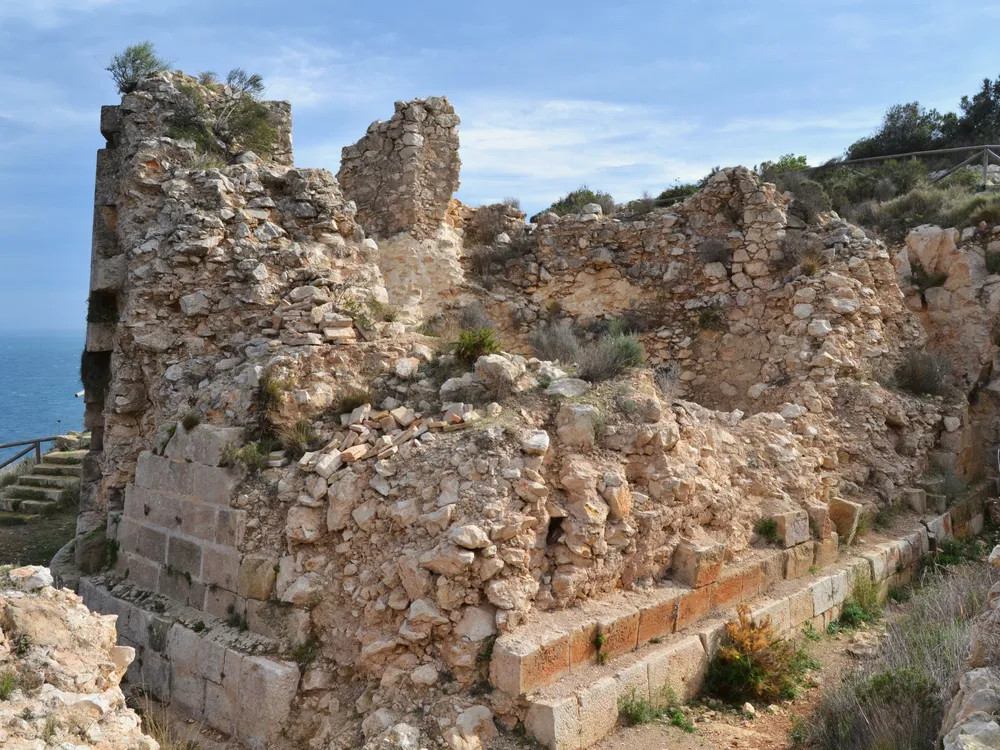
Castell de la Granadella
An 18th-century coastal battery declared of Cultural Interest in 1996, the Castell de la Granadella defended Jávea with a garrison of three men and two bronze cannons. Its horseshoe-shaped foundation survives among the scrub, the only publicly preserved coastal fort in the region.
Despite its name, the Castell de la Granadella was never a castle but an 18th-century coastal battery, built in 1739 on the Morro de la Xapa headland at the mouth of Cala de la Granadella. It belonged to the chain of defensive towers and batteries that once ringed this Mediterranean coastline against Barbary pirate raids, a system with a comparable example in neighbouring Teulada-Moraira. Positioned to cover the mouth of the cove, the battery could exchange visual signals with neighbouring towers along the coast whenever sails were sighted offshore, part of a relay network that gave inland villages time to prepare before raiders reached the shore.
A skeleton garrison
Its horseshoe-shaped plan and solid construction housed a garrison of just three soldiers manning two bronze cannons. The structure is thought to have stood around seventeen metres tall, though its upper section no longer survives. During the Peninsular War, French troops occupied and looted parts of it, and it appears to have also been shelled from French ships anchored in the cove itself, leaving it largely in ruins.
What survives today
Declared an Asset of Cultural Interest in 1996, it is the only publicly owned coastal fortification still standing on the Jávea coastline, though its condition remains fragile and much of its walls are overgrown. It's reached on foot from the car park at the cove, and the short climb to the headland opens up one of the widest views on the coast, worth ranking among the area's best viewpoints, with Cap de la Nau visible to the south. Closed shoes help, since the final stretch crosses loose stone and low scrub.
Frequently asked questions
Is it free to visit the Castell de la Granadella?
Yes, it's open year-round at no cost, since it's an open-air ruin with no ticket booth.
How long does it take to get there from the cove?
It's a short climb, around ten minutes on foot from the car park at Cala de la Granadella.
Why is it called a castle if it was a battery?
The popular name stuck over time, but its actual role was as a coastal artillery battery with a minimal garrison, not an inhabited castle.
Comments
Sign in with Google to comment and rate
Be the first to comment.