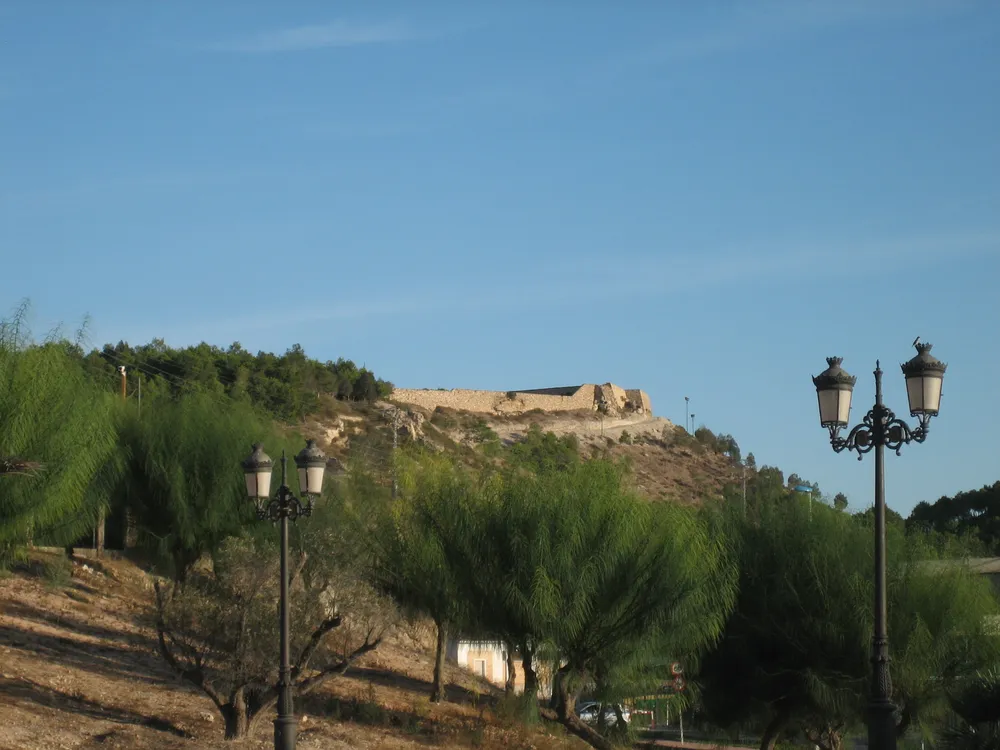
Castillo de Guardamar
14th-century fortress of Islamic origin on a rocky hill beside the town. Damaged in the 1829 earthquake, it retains a Gothic wall modified in the 16th century with tower bases.
Guardamar castle crowns the hill above the town, overlooking the final stretch of the Segura River before it reaches the sea. Its origins lie in an Islamic-era fortification that predates the Christian conquest; Jaime I took it in 1264, and almost a century later Pedro I "the Cruel" occupied it again in 1359 during the War of the Two Pedros between the crowns of Castile and Aragon. Listed as a Bien de Interés Cultural since 1985, it can now be visited as part of the same dune-park route that includes La Fonteta and the Rábita Califal.
History
After the Christian conquest, the site was laid out in two parts: the fortress itself on the highest ground, and a small walled settlement below it with a square, a church and houses. That layout held until 23 March 1829, when a major earthquake shook the whole Vega Baja del Segura, killing hundreds of people and ruining much of the region's buildings. The castle was badly damaged, and the town chose to rebuild on safer ground away from the hillside, leaving the fortress as it stands today: a consolidated ruin.
What to see
Surviving remains include stretches of the double polygonal wall, several tower bases and a later bastion added when the fortress was adapted for firearms. Ongoing archaeological digs have recovered part of the layout of the old citadel. Besides the castle itself, the main draw of the climb is the view over the mouth of the Segura, the dune pine forest and the coastline to the south.
The path up has a slope but no technical difficulty, and it is worth avoiding the middle of the day in summer, since much of the route has little shade. For anyone visiting the town, it makes a good first stop for getting your bearings before heading down to the dunes and the rest of the archaeological park.
Frequently asked questions
Can you go inside Guardamar castle?
Yes, though it is a consolidated ruin and entry is ticketed; it is usually visited together with La Fonteta and the Rábita Califal.
When is the best time to climb up?
Spring and autumn are the most comfortable seasons, since the path has little shade and summer midday heat can make the climb tough.
What can you see from the castle?
The mouth of the Segura River, the dune pine forest, and much of the coastline south along the Vega Baja.
Comments
Sign in with Google to comment and rate
Be the first to comment.