What to see in Guardamar del Segura
Guardamar del Segura sits at the mouth of the Segura river, at the southern tip of Alicante province, and is the southernmost Valencian-speaking municipality in the whole of the Valencian Community. Its history as a coastal settlement runs deep: at La Fonteta, next to the riverbed, archaeologists have excavated the remains of a Phoenician settlement dating from the 8th to the 6th century BC since 1996, one of the best-preserved in the entire western Mediterranean.
History
During the Islamic period, the site held a rábita — a fortified religious retreat — founded in the year 944 and considered one of the oldest surviving structures of its kind in Spain; its remains, the Rábita Califal, can be visited today. After the Christian conquest around 1244 and the formal founding of the town around 1277, Guardamar grew around a 14th-century castle whose upper, Arab-era section was destroyed by the 1829 earthquake, one of the most violent in the region's history. The quake levelled much of the medieval core and forced a rebuild along the straight neoclassical streets that still define the town centre today.
What to see
The other defining feature of Guardamar is La Pinada, a pine forest of more than 800 hectares planted between 1897 and 1929 to stop dunes from advancing over the town and its farmland; today it separates the town centre from eleven kilometres of fine-sand beaches that run along almost the entire municipal coastline. At the mouth of the Segura, marshland vegetation attracts herons, ducks and other waterbirds, and several marked trails let visitors cross the dunes, pine forest and wetland on foot or by bike without leaving the municipality.
Guardamar was named Cultural Capital of the Valencian Community in 2023, reflecting the weight local authorities have put on preserving its archaeological and historical heritage. The mix of sites from different eras, long beaches and a protected natural setting makes it a destination that packs history and coast into a relatively small area, not far from Santa Pola. The municipality, which officially adopted the name "Guardamar del Segura" in 1916, today has around 18,500 residents, close to a third of them foreign-born. The early-20th-century Molino de San Antonio, with its neo-Mudéjar decoration, and the traditional Fiesta del Árbol, held without interruption since 1902, round out a heritage that mixes nature, history and an unusually long-running relationship with forest replanting, a pattern common to several towns along this stretch of the Vega Baja coast.
🚆 How to get there from Alicante
Guardamar del Segura sits in the south of the province, at the mouth of the Segura river, a little over half an hour's drive from Alicante along the N-332 or the dual carriageway toward Cartagena. It's also reachable via inland roads from Elche or Orihuela, both linked to the province's motorway network. Interurban bus lines connect Guardamar with Alicante and neighbouring Vega Baja towns, though a car remains the most flexible way to get around, especially for reaching the different beach stretches and La Pinada. The municipality has no train station. Local buses also serve the town from Elche and Torrevieja for travellers without a car.
Compare all towns by transport →
-
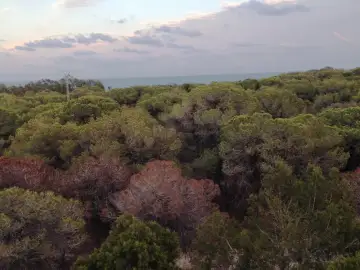 Beach & nature · FREEDunas de GuardamarGuardamar del Segura — Baix Segura (Alacant)
Fixed dune forest covering 800 hectares, planted with pines in the early 20th century to halt the advance of mobile coastal sand.
- 🗿MonumentLa FontetaGuardamar del Segura — Baix Segura (Alacant)
Phoenician port settlement from the 8th–6th centuries BC, among the largest and best-preserved in the western Mediterranean.
-
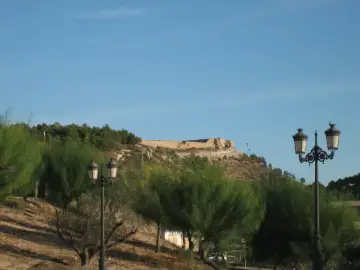 CastleCastillo de GuardamarGuardamar del Segura — Baix Segura (Alacant)
14th-century fortress of Islamic origin on a rocky hill beside the town.
- 🗿MonumentRábita CalifalGuardamar del Segura — Baix Segura (Alacant)
10th-century Islamic monastery founded in 944, the first ribat discovered in Spain.
Frequently asked questions
What is La Fonteta in Guardamar?
It's a Phoenician archaeological site from the 8th to 6th century BC, one of the best-preserved Phoenician settlements in the western Mediterranean.
Is Guardamar a good destination for families?
Yes, it combines long, fine-sand beaches with the La Pinada forest, which offers shade and gentle trails suited to all ages.
What's the best time to visit Guardamar del Segura?
Spring and autumn bring mild temperatures for exploring the dunes and La Pinada; summer sees the biggest crowds on the beaches.