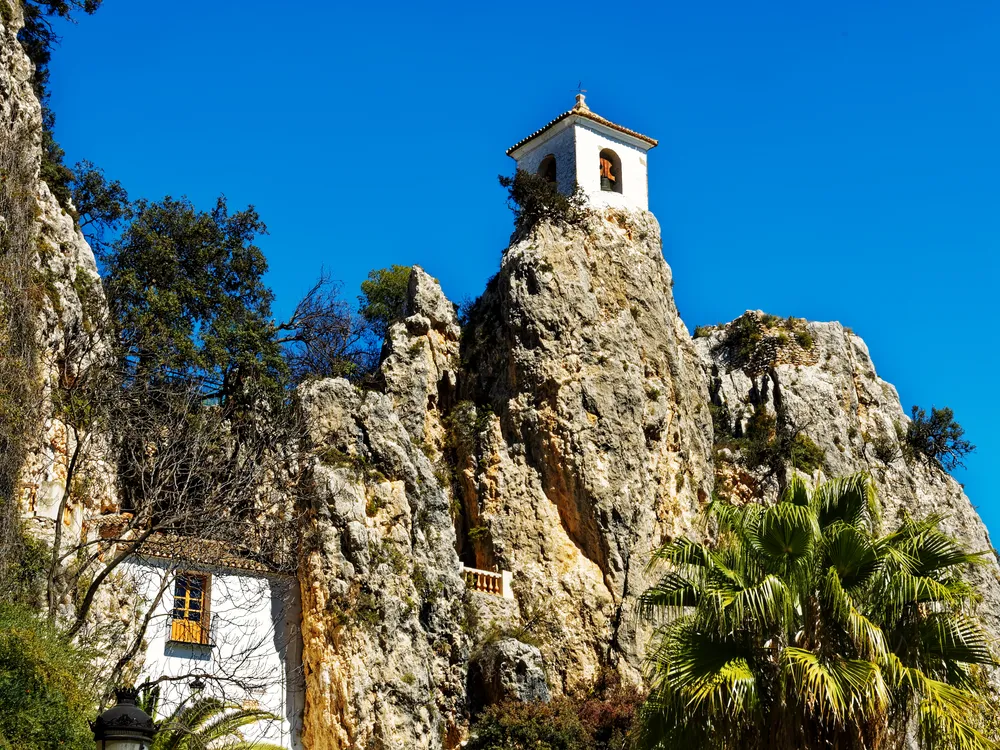
Castillo de San José
11th-century fortress built during Muslim occupation at the highest point of the rocky peak. The earthquakes of 1644 and 1748, and the explosion of 1708 during the War of Succession, destroyed most of its walls. A historic-artistic monument since 1993, offering panoramic views of the valley from its remains.
A fortress built into the rock
Castillo de San José crowns the highest point of the crag that Guadalest is built on, a fortress raised in the 11th century during Muslim rule. After the Christian conquest, the troops of Jaime I took the stronghold and the king granted it to the Vidal de Sarrià family, who held it until 1335. Next to Castillo de San José, on the same outcrop, stood a second defensive enclosure, the Castillo de la Alcozaiba, together forming a single defence system for the valley.
The castle's later history is a string of natural and wartime disasters. On 22 June 1644 an earthquake destroyed much of the fortress, and months later, in December of the same year, another powerful tremor struck the area again; further, smaller earthquakes followed in 1748 and 1752. On top of this, in 1708, during the War of the Spanish Succession, an explosion badly damaged the castle's western wing and set fire to the neighbouring Casa Orduña, an episode that marked the end of the fortress's military role in the area.
A ruin with valley views
Declared a historic-artistic monument in 1993, the castle today is visited as a set of ruins that still holds part of its walls, the old dungeon and a cemetery within its own grounds, along with natural viewpoints over the valley and the reservoir. Access is through the Portal de San José, a passage cut into the rock that remains the traditional entrance to the site, and the visit pairs well with a climb up the nearby Penyó de l'Alcalà, another of the village's viewpoints.
Frequently asked questions
Is Castillo de San José ticketed?
Yes, there's an entry fee to visit the site.
How long does it take to see?
Since it's a small ruined site, a relaxed visit takes about 30 to 45 minutes.
Is it accessible for visitors with reduced mobility?
Not especially — the approach is via steep narrow lanes and a rock-cut passage, with steps and uneven ground.
Comments
Sign in with Google to comment and rate
Be the first to comment.