What to see in Altea
Altea rises on a hillside that descends toward the sea through cobbled lanes, crowned by the blue-and-white tiled dome of the Iglesia de Nuestra Señora del Consuelo, the town's most recognisable image. The old quarter, known locally as El Fornet, keeps that layout of whitewashed houses that led National Geographic in 2024 to name Altea its recommended village to visit in July, citing the balance it still holds between heritage, landscape and everyday life.
From Roman settlement to the 1617 town charter
Iberian, Roman and Islamic-era remains have been documented within Altea's territory, from a time when the area belonged to the Taifa of Denia. James I of Aragón took the town in 1244, and Pedro III granted it a founding charter in 1279, but the medieval settlement was abandoned between the 14th and 15th centuries. The town was refounded on its present site under a new charter issued in 1617, and it's around that layout that today's village was built. Much of it survives in the narrow, sloping streets that still make up the old quarter today.
The Russian church and the artistic community
The Altea Hills development is home to the first Russian Orthodox church built on the Iberian Peninsula, dedicated to the Archangel Michael. It replicates a 17th-century wooden church from the Arkhangelsk region, raised with materials brought from the Urals and built by Russian craftsmen; the first stone was laid in 2002 and the church was consecrated in 2007. That mix of traditions fits Altea's reputation as a place that has drawn painters, ceramicists and musicians through the 20th century, a reputation that still attracts artists today.
The municipality's coast combines cliffs and coves along more than six kilometres of shoreline: the Serra Gelada Natural Park covers the southern stretch, Playa La Roda is the main bathing beach next to the town, and the smaller Mascarat Beach sits tucked beside the gorge of the same name. Inland, the Forat de Bernia, a natural opening through the neighbouring mountains, is a popular hiking destination. With a little over 24,000 registered residents — barely 5,000 around 1960 — Altea holds its Moros y Cristianos festival on the fourth weekend of September, honouring the Santísimo Cristo del Sagrario and San Blas. In June, the Plantà de l'Arbret revives an agricultural-rooted ritual tied to the summer solstice, and in August the Castell de l'Olla sets off fireworks from boats moored off the seafront.
🚆 How to get there from Alicante
Altea lies around 55 kilometres from Alicante, in the Marina Baixa district, and is reachable by tram, bus or car without difficulty. The metropolitan TRAM covers the route by combining line 1 to Benidorm with line 9, which stops in Altea's own town centre; the full journey takes roughly an hour and a quarter. By road, the AP-7 motorway links the two towns in around 45 minutes under normal conditions. Regular buses also run from Alicante's bus station, with frequent departures through the day as one of the usual stops on the route north along the province. Once in Altea, the old town itself is best explored on foot rather than by car.
Compare all towns by transport →
-
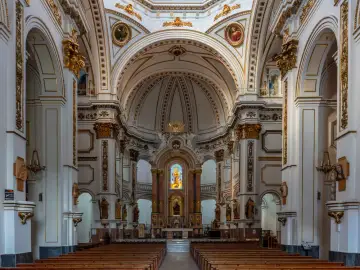 Church · FREEIglesia de Nuestra Señora del ConsueloAltea — Marina Baixa (Alacant)
Eighteenth-century church crowned by its iconic blue and white tile dome, dominating Altea's historic old town.
-
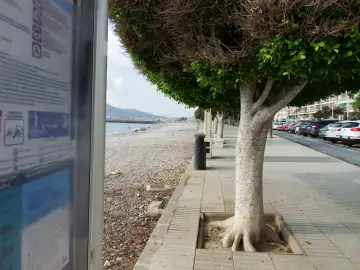 Beach & nature · FREEPlaya La RodaAltea — Marina Baixa (Alacant)
Gravel beach with sand patches in central Altea, sheltered by breakwaters that create calm waters.
- 🌳Garden · FREESerra Gelada Natural ParkAltea — Marina Baixa (Alacant)
Natural park of 5,000 hectares between Altea and Benidorm with 300-metre cliffs, reserves of rare flora and trails to viewpoints.
- 🏔️Viewpoint · FREEForat de BerniaAltea — Marina Baixa (Alacant)
A natural piedra caliza (limestone) tunnel that cuts through the Sierra de Bernia, used by shepherds for centuries.
- 🌿Beach & nature · FREEMascarat BeachAltea — Marina Baixa (Alacant)
Rocky cove within Serra Gelada Natural Park, 280 metres long with crystal-clear waters ideal for snorkelling and underwater exploration.
Frequently asked questions
Does the tram reach Altea's old town?
The TRAM stop sits close to the centre, a short walk from the church and the old quarter, though the climb up to the higher streets is steep.
Can you visit the Russian Orthodox church?
Yes, the Templo del Arcángel Miguel, in the Altea Hills development, is open to visitors; it's worth checking opening times before going, since they don't match the rest of the village.
What's the best time to walk through the old town?
Early morning and early evening, especially outside the summer months, make it easier to walk the cobbled streets with less heat and fewer crowds.