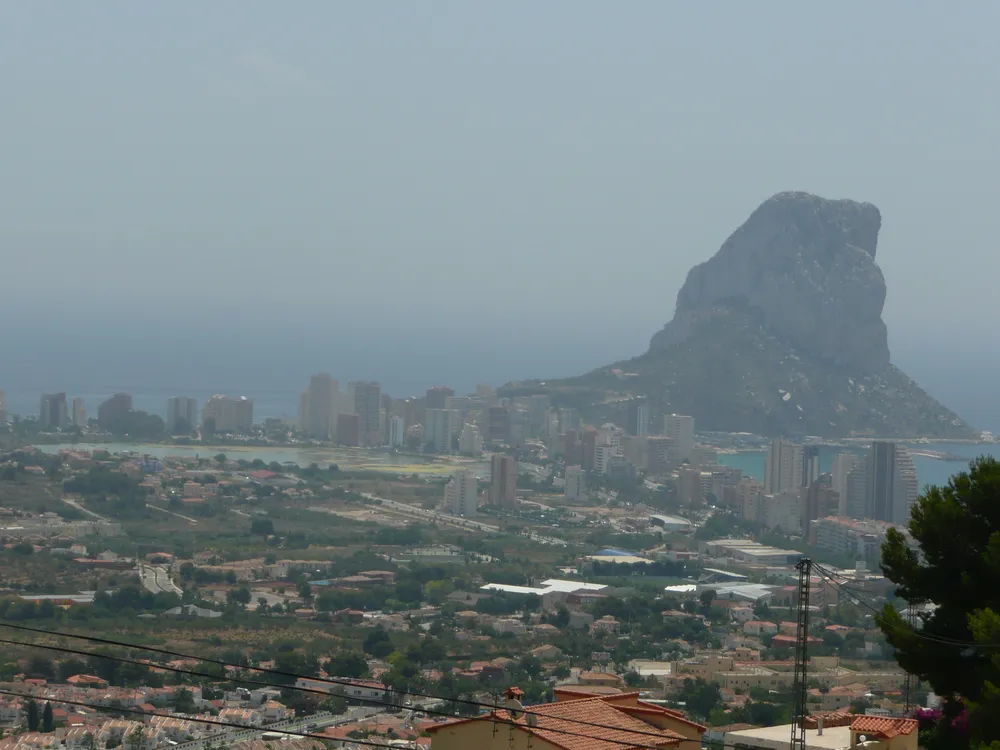
Peñón de Ifach
A 332‑metre calcareous massif that rises from the Mediterranean, linked to land by a rocky isthmus. A natural park covering 45 hectares, the smallest in Spain, home to more than 300 endemic animal and plant species.
The Peñón de Ifach is a limestone outcrop 332 metres tall and just over a kilometre long that rises almost sheer from the sea, joined to the mainland by a narrow isthmus, in Calpe. It formed more than 300 million years ago, during the Triassic period, and over the centuries served as a landmark for Phoenician sailors and a lookout point for Romans and Muslims, who used its height to watch over the coast.
One of the smallest natural parks
The regional government declared it a natural park on 19 January 1987, with an initial area of 45 hectares that made it one of the smallest natural parks in Spain; it was expanded to 53.3 hectares in 2015. The rock is home to more than 400 catalogued plant species, some of them endemic and endangered, such as the Ifach silene, and its cliffs shelter colonies of seabirds, including the European shag and the peregrine falcon.
Climbing to the top
A tunnel cut through the rock connects its two flanks and leads to the route up to the summit, which has limited access and requires booking in advance. From up there, and also from the base near the Baños de la Reina, the views stretch across much of the Marina Alta coastline. The rock is also visible from the Murallas Medievales del Casco Antiguo and from the Torre de la Peça, two more stops on a walk through Calpe's heritage, and a regular feature on lists of the area's best viewpoints.
Frequently asked questions
Is it free to visit the Peñón de Ifach?
Walking the base and the isthmus is free, but the route up to the summit through the tunnel requires advance booking and has limited access.
How long does it take to reach the summit?
The full round trip takes around two and a half to three hours at a moderate pace; the first stretch up to the tunnel is manageable even with children, but the path gets steeper and rockier beyond that point.
Why is it called one of the smallest natural parks?
Because its original area, 45 hectares, made it one of the smallest protected areas in Spain when it was declared a natural park in 1987.
Comments
Sign in with Google to comment and rate
Be the first to comment.