Capilla Ecce Homo
18th-century Baroque chapel with octagonal floor plan topped by a glazed-tile dome. Designed by Franciscan architect Francisco Cabezas with Eastern influences.
The Capilla del Ecce Homo is Pego's most distinctive religious building, with an octagonal floor plan 12.5 metres across, topped by a blue-tiled dome that reaches 14.5 metres in height. It was designed by the Franciscan architect Francisco Cabezas, who also built other churches across the Comunitat Valenciana, such as the Santa Faz in Alicante, and construction began on 1 November 1759, funded by contributions from the town's own residents.
History
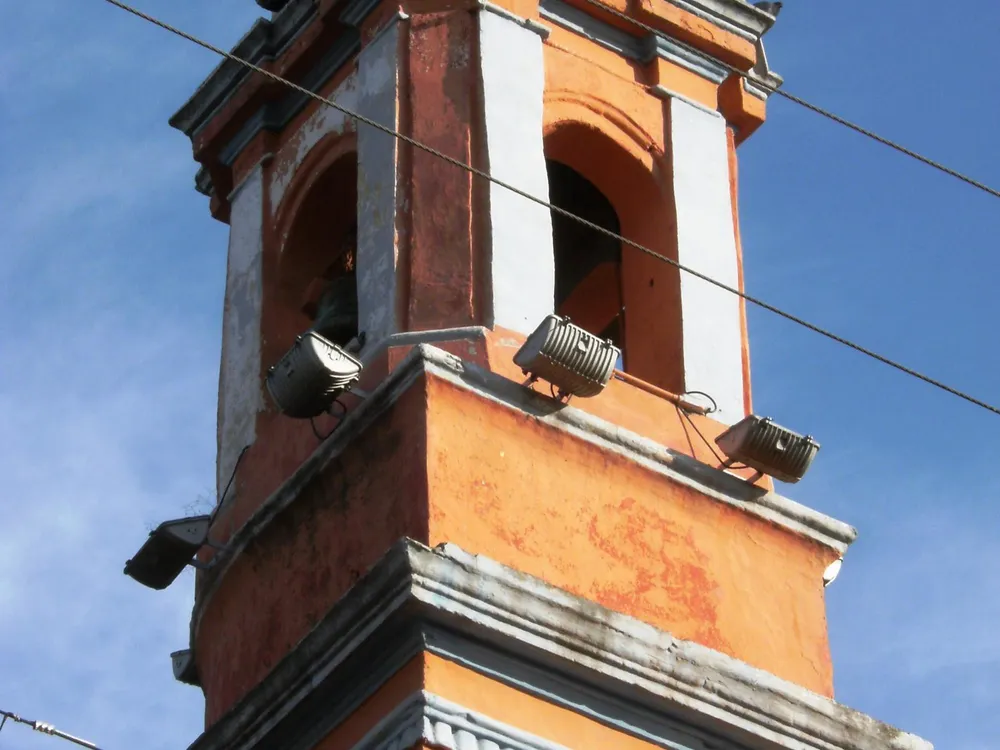
The chapel was blessed in 1776, though finishing work continued for some years afterwards. A triangular bell tower was added in 1850, completing the building as it stands today. Inside, the chapel houses a 16th–17th-century wooden statue of the Ecce Homo, Pego's patron image, surrounded by golden-toned decoration and painted medallions on the dome depicting Christian iconography.
What to see
Cabezas used a centralised floor plan covered by a dome, with a ring of chapels around it that becomes a continuous gallery on the upper level, lit from above — an unusual solution among the religious architecture of the area. The plain exterior contrasts with the richly decorated interior, one of the best examples of late Baroque style in the Marina Alta.
It stands right in the middle of Pego's old town, a short walk from the Iglesia Arciprestal de la Asunción, so both churches can be seen on the same walk, along with the route up to the Castell d'Ambra for those who want to pair religious architecture with medieval heritage. It also makes a good option on a sticky day at the Marjal de Pego-Oliva, when it helps to alternate the wetland with indoor stops in town.
Frequently asked questions
Can you go inside to see the interior?
Yes, though entry is ticketed outside religious services, given the value of the interior decoration and the Ecce Homo statue.
Why does it have an octagonal shape?
It was a choice by architect Francisco Cabezas, who used an unusual centralised floor plan for 18th-century Valencian religious architecture.
Is it close to Pego's other landmarks?
Yes, it is a few minutes' walk from the Iglesia Arciprestal de la Asunción and the town's old quarter.
Comments
Sign in with Google to comment and rate
Be the first to comment.