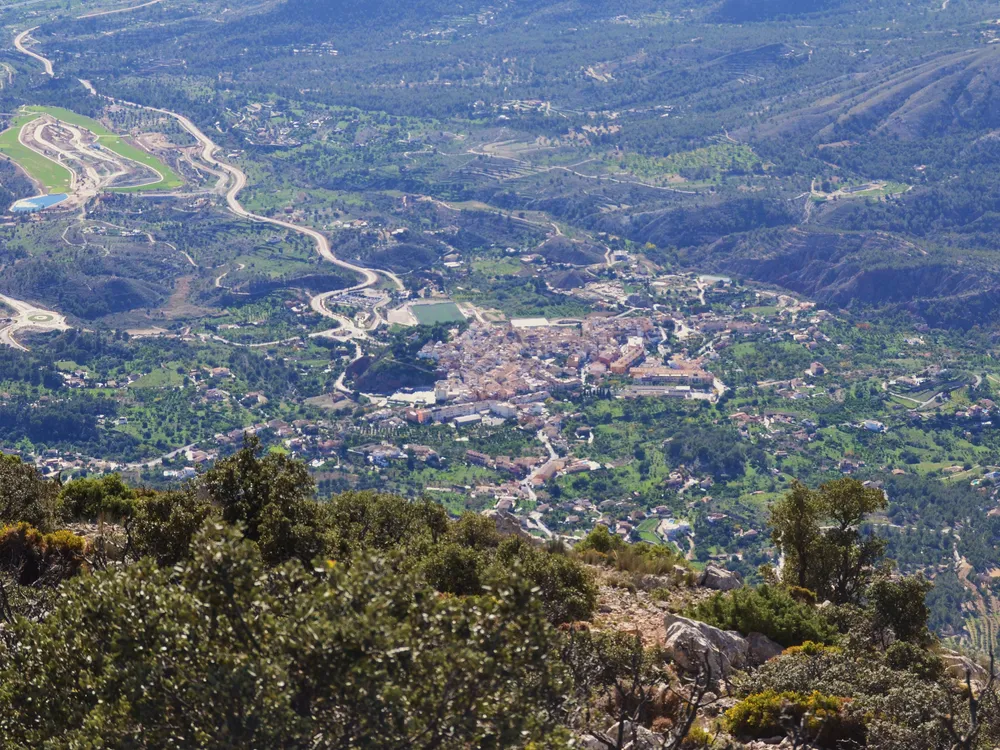
What to see in Finestrat
Finestrat is a hillside town in the Marina Baixa comarca, stacked in tiers below Puig Campana, the Costa Blanca's most recognisable mountain at 1,410 metres. Its old quarter keeps a knot of narrow lanes and whitewashed houses that appear to hang off the slope, a layout typical of the defensive hilltop settlements that once watched over the pass between the mountains and the sea.
History
The remains of a 12th-century Almohad-era fortress still stand at the top of the village, now reused as a viewpoint over the coast toward Alicante. For centuries the population lived exposed to raids by Barbary pirates, which explains the defensive, elevated layout of the original settlement. The church of Sant Bartomeu, built in 1751 with a facade that mixes late Baroque and Neoclassical lines, presides over the main square and lends its name to the patron-saint festivities at the end of August.
What to see
The Font del Molí, a stone fountain with fifteen spouts, is the usual starting point for the walking routes up Puig Campana and a traditional meeting spot for locals. Close to the old quarter, the hermitage of the Santísimo Cristo del Remedio adds a second point of religious interest to a route that can be covered almost entirely on foot. Despite sitting only 41 kilometres from Alicante, Finestrat keeps the feel of an inland village, even though it touches the coast along a tiny stretch of just a few hundred metres next to its own cove — one of the shortest coastlines of any coastal municipality in Spain. The Terra Mítica theme park, meanwhile, sits right on the boundary between Finestrat and Benidorm.
In recent decades the village has grown as a residential area for people working in nearby Benidorm's tourism industry, without losing its original agricultural base: almond, olive and orange trees still cover the gentler slopes. For visitors who want the outdoors without straying far from the coast, Finestrat combines mountain hiking — sections of the Puig Campana ascent suit different fitness levels — with a beach just minutes away by car. Spring and autumn are the best seasons for the climb, when milder temperatures make the elevation gain easier; in high summer an early start is worth it. The municipality now has close to 9,900 residents according to the latest census, a figure that has multiplied over recent decades through residential growth. On the table, dishes like arròs amb fesols i naps (rice with beans) and coca girada, a savoury pastry, keep the inland cooking tradition alive, with the festivities of San Antonio Abad in January and San Blas in February rounding out the calendar alongside Sant Joan at the end of June.
🚆 How to get there from Alicante
Finestrat lies about 41 kilometres north of Alicante, in the Marina Baixa comarca. The most direct way in by car is the AP-7 motorway or the N-332 road as far as Benidorm, then following signs inland; the drive usually takes around three-quarters of an hour depending on traffic through the Benidorm bypass. Travellers without a car can take a bus or the TRAM light rail to Benidorm and cover the last stretch on a local connecting service, since the village sits only minutes from the resort's centre. Finestrat has no train station of its own, so a car or bus is the usual way in from the provincial capital.
Compare all towns by transport →
-
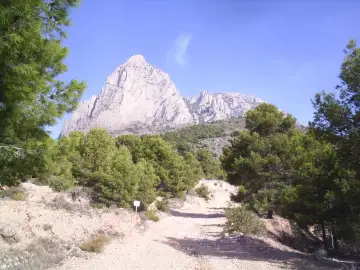 Viewpoint · FREEPuig CampanaFinestrat — Marina Baixa (Alacant)
Alicante's second-highest peak at 1,406 metres with distinctive conical shape and a notable split at the summit known as Tajo de Roldán.
-
 Church · FREEIglesia de Sant BartomeuFinestrat — Marina Baixa (Alacant)
18th-century church in Finestrat's old town, situated on winding medieval streets.
-
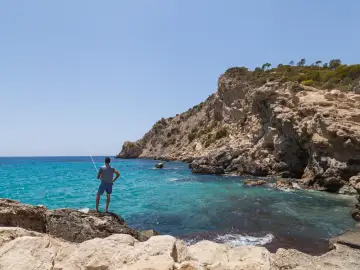 Beach & nature · FREECala de FinestratFinestrat — Marina Baixa (Alacant)
Fine-sand beach, 270 metres long, with clear waters and Blue Flag status.
-
 Church · FREEErmita del Santísimo Cristo del RemedioFinestrat — Marina Baixa (Alacant)
Hermitage located at Castell de Finestrat at the municipality's highest point with panoramic views.
Frequently asked questions
Is Finestrat a good base for hiking?
Yes, it's the usual starting point for climbing Puig Campana, with several routes beginning near the Font del Molí and sections suited to different fitness levels.
Does Finestrat have its own beach?
It has a very short stretch of coastline, just a few hundred metres, next to its cove; most of the area's beach life is concentrated in neighbouring Benidorm.
What's the best time to visit Finestrat?
Spring and autumn bring milder temperatures for climbing Puig Campana; the old quarter and church can be visited year-round.