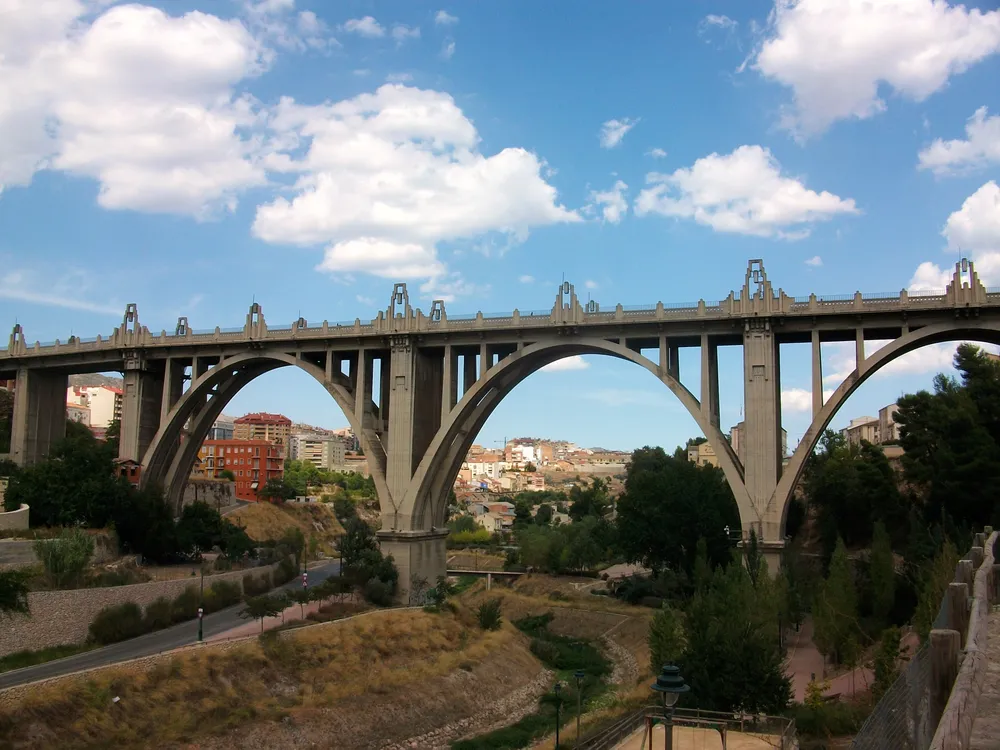
Puente de Sant Jordi
Art deco bridge completed in 1931, 245 metres long and 45 metres high, built in innovative reinforced concrete. Named after Alcoy's patron, it is the city's most iconic image and one of Spain's most important art deco structures, central to the Moros y Cristianos festival.
The Puente de Sant Jordi crosses the Riquer ravine in the centre of Alcoy and, alongside the city's old industrial chimneys, is its most recognisable structure. It was built between 1925 and 1931 and opened on 26 March of that year, after six years of work funded by the town council itself.
A landmark in reinforced concrete
At 245 metres long and 45 metres high, the bridge is made up of three large arches with a 46-metre span, formed by twin parabolic vaults. It's one of the first large-scale structures built entirely in exposed reinforced concrete in Spain, and one of the country's few strong examples of Art Deco applied to civil engineering. The piers combine dressed stone and masonry, resting on four main supports.
The bridge takes its name from Sant Jordi, Alcoy's patron saint, to whom the city's Moros y Cristianos festival is dedicated each year, a celebration declared a Festival of International Tourist Interest. The structure links two parts of the city divided by the ravine and, thanks to its height, offers an unusual view over Alcoy's street layout.
It stands in the centre of Alcoy, close to the Museo Arqueológico Camilo Visedo Moltó and the Casa de la Cultura, making it easy to see on the same walk through the city before or after heading up to natural areas such as the Sierra de Mariola.
Frequently asked questions
Is it free to see the bridge?
Yes, it's a public structure and can be crossed and photographed at no cost.
Why is it called Puente de Sant Jordi?
After Alcoy's patron saint, to whom the city's Moros y Cristianos festival is dedicated.
What makes it architecturally significant?
It's one of Spain's first large-scale structures built in exposed reinforced concrete, and a notable example of Art Deco applied to civil engineering.
Comments
Sign in with Google to comment and rate
Be the first to comment.