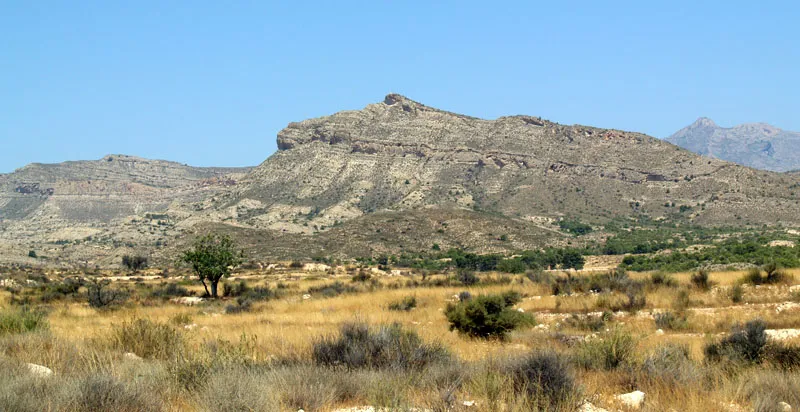
Microrreserva Bec de l'Àguila
A 4.73-hectare microreserve between El Campello and Mutxamel protecting Vella lucentina, a small crucifer endemic only to Alicante with fewer than ten known populations anywhere in the world today in total.
TL;DR: The Bec de l'Àguila microreserve, 4.73 hectares between El Campello and Mutxamel, protects the largest known population of Vella lucentina, a woody crucifer endemic to a handful of hills around Alicante. It is signposted, free and visited on foot without leaving the tracks.
Bec de l'Àguila is a low marly hill of just 4.73 hectares tucked between its namesake ravine and the head of the Seco river, straddling El Campello and Mutxamel about 12 kilometres from Alicante. It was declared a plant microreserve by Order of 4 May 1999 of the Valencian environment department (DOGV No. 3505) and is one of 312 microreserves that, according to the Generalitat Valenciana, form Europe's densest network of tiny protected plots for endemics. The reason here is a single species: Vella lucentina, a woody crucifer described in 1992 that grows only on gypsum-rich white marls around Alicante. Bec holds the largest, best-structured population, with several hundred reproductive plants, while all other known sites number fewer than ten and are smaller.
Why does such a small plot deserve strong protection?
Valencian microreserves were invented to protect what a natural park cannot: endemics that live on one specific slope and would vanish with a quarry, a road widening or a ploughing. Vella lucentina occupies white marl with gypsum, a poor substrate where few plants compete and where it forms low cushions of fleshy leaves and yellow flowers March to May. Outside those marls it does not survive, which is why its world range fits on a handful of hills between Alicante, El Campello and Sant Vicent del Raspeig. The Generalitat lists some 300–400 priority plants across the Comunitat, and Vella lucentina ranks among the most threatened for its tiny area. At Bec you also find Helianthemum caput-felis and Sideritis leucantha subsp. albicaulis, both on the Valencian Catalogue of Threatened Species, plus alfa grass and tussock that structure the steppe. Stepping off the path, pulling a shrub or riding a mountain bike across the slope can wipe out plants that took years to establish, because regeneration on this soil is extremely slow.
How do you visit without damaging what you came to see?
The reserve takes less than half an hour to walk, but it deserves a slow pace and staying on the marked way. The easiest access is from Mutxamel via the Camí del Bec de l'Àguila, a dirt track drivable to a clearing where you can park without entering the signposted perimeter; from El Campello you can link farm lanes that connect to Muchavista Beach if you want coast and dryland in one morning. There is no shade or water, so bring both and avoid midday in summer: glare off the white marl doubles the sense of heat. Flowering of Vella lucentina, March to May, is the best window to identify it without touching: four-petalled yellow flowers clustered on creeping mats no taller than 30 centimetres. Outside that window the plant blends into scrub, but the steppe remains a good walk to understand the semi-arid landscape around Alicante that few visitors associate with the Costa Blanca.
What 4.73 hectares mean: the Valencian microreserve model through one concrete example
The microreserve figure, created by Decree 218/1994 and implemented by the Order of 4 May 1999 that declares Bec de l'Àguila, lets the Generalitat Valenciana protect plots under 20 hectares with management tailored to one or two target species, without expropriation or creating a full natural park. The Comunitat now has 312 microreserves totalling about 2,468 hectares, a network the environment department presents as pioneering in Europe for concentrating a very significant share of Valencian endemic flora in less than 0.1% of the territory. Bec de l'Àguila, at 4.73 hectares, illustrates the model perfectly: a perimeter marked only by information posts, no permanent staff, where monitoring is done by technicians who census each spring how many shrubs flower and how many seedlings appear, and where the main threat is not mass tourism but expansion of dryland farming or dumping of rubble. The declaration order bans picking plants, disturbing soil or leaving the track, and requires owners to keep traditional dry farming that, paradoxically, has preserved the habitat by preventing building.
When to go and what to pair nearby?
March to May is the optimal window to see Vella lucentina in flower and to walk without extreme heat; in summer keep the walk short and start early. Autumn, after first rains, is also good because the steppe greens up and the ravine carries some water. As the visit barely takes an hour, most people pair it with the coast at Illeta dels Banyets, with the El Campello seafront or with a shady plan from gardens and parks in Alicante. From Benidorm or Altea you can get there in under 45 minutes via the AP-7 and A-70, returning via Xixona if you want turrón and mountains to complete the day. From Orihuela or Elche the drive exceeds an hour, so it makes more sense to stay in Alicante and give the morning to the dryland. Remember the reserve has no bins or toilets: carry a bag for litter and do not stack stones or leave marks.
Microreserve in AlicanteAreaTarget speciesDesignationBec de l'Àguila (El Campello/Mutxamel)4.73 haVella lucentinaOrder 04/05/1999, DOGV 3505Barranc de la Higuerica (Orihuela)20 haCentaurea saxicola + salt steppeOrder 03/11/2005Cap de Sant Antoni (Xàbia)~3 haHippocrepis valentinaOrder 1998Serra de Mariola (Alcoi)Various 1–10 haLinaria cavanillesiiDecree 218/1994To go deeper, see day trips from Alicante and the guide to best viewpoints near Alicante if you want a high point after the visit. The MARQ and MUBAG in Alicante round off the day with culture without leaving the city. And if the stewardship model interests you, the Valencian microreserve network is documented by the Generalitat on its Biodiversity portal with downloadable species sheets.
Frequently asked questions about Bec de l'Àguila?
No plant or seed may be collected and you must stay on the path: Vella lucentina seedlings are only millimetres across and a single footstep destroys them. Visiting is free year-round, no booking needed.
Tip: Go between March and May to see Vella lucentina in bloom, an endemic plant found only here — stay on the marked path.
Frequently asked questions
Can you visit Bec de l'Àguila freely?
Yes, access is free year-round with no timetable or booking. Just stay on the marked path and inside the signposted perimeter.
When does Vella lucentina flower?
March to May. That is the best time to identify it by its four-petalled yellow flowers without touching the plant.
Can I bring a dog or a bike?
Not advisable: off-lead dogs and bikes off track damage seedlings and break the soil crust. If you bring a dog, keep it leashed on the path.
Comments
Sign in with Google to comment and rate
Be the first to comment.