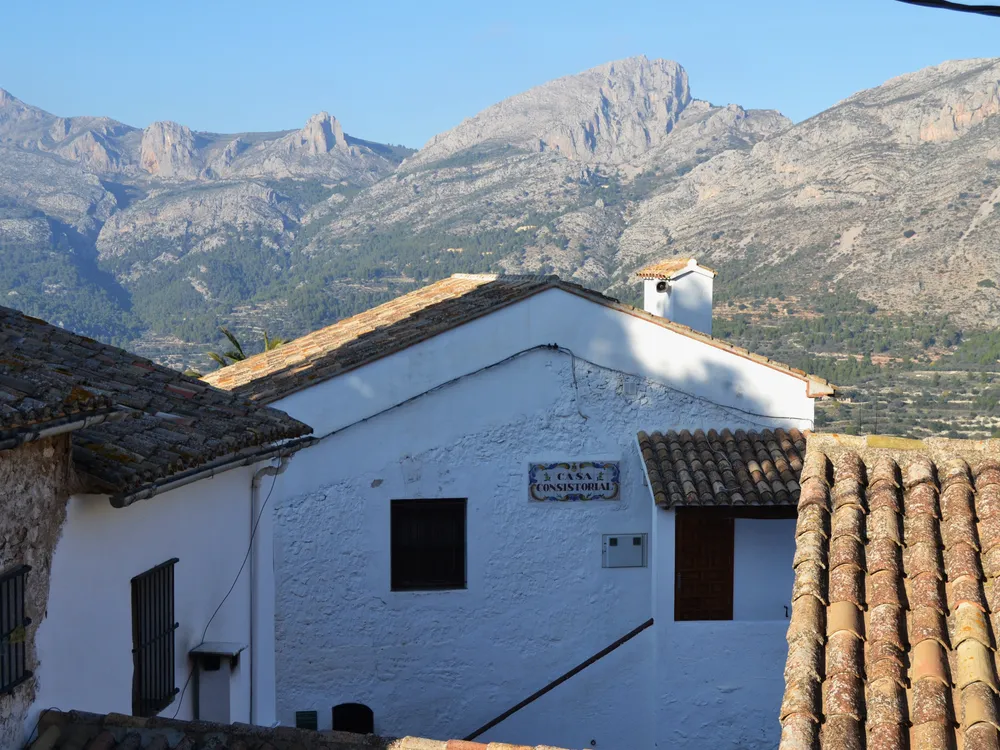
El Castell de Guadalest
Small town of fewer than 200 inhabitants from the 11th century, though founded during Arab occupation. Divided into two neighborhoods: the medieval citadel accessible by tunnel carved into the rock, and the Arrabal. Two castles, a solitary bell tower and five museums make Guadalest a unique destination on the Costa Blanca.
El Castell de Guadalest is the walled hilltop settlement that gives Guadalest its name, one of the smallest municipalities in Alicante province, with a registered population of just 284. Its origins go back to the Muslim period, when two fortifications were raised on the rock to watch over the valley: the Castillo de San José and the smaller Alcozaiba castle. In 1293, King Jaime II of Aragón granted the castle to Bernardo de Sarrià, and it passed through a succession of noble families over the centuries that followed.
A village split in two
Guadalest is divided into two very different parts. The Arrabal is the newer district that grew at the foot of the rock and holds most of the shops and parking. The medieval citadel, by contrast, is reached only through a tunnel of around fifteen metres carved straight into the stone, the Portal de San José, a piece of 17th-century defensive engineering that remains the only way into the walled enclosure.
Inside the citadel, cobbled lanes lead to the village's museums, including the Museum of Microminiatures, and to the Plaça de Sant Gregori viewpoint, which looks out over the turquoise reservoir. The village's most photographed feature is El Campanario, the bell tower that stands alone on a separate outcrop above the rooftops.
Earthquakes and rebuilding
The castle was damaged by earthquakes in 1644 and 1748, and in 1708, during the War of the Spanish Succession, part of its western flank was demolished. Despite the repeated damage, enough of the historic complex survives that it was declared a historic-artistic ensemble in 1974, and it remains one of the most visited inland destinations on the Costa Blanca, drawing far more visitors each year than its tiny resident population would suggest. Most people arrive as a half-day trip from the coast, walking the citadel's lanes before heading back down through the same rock tunnel.
Frequently asked questions
Is it free to enter El Castell de Guadalest?
No, entering the walled citadel requires a paid ticket that covers several of its museums; walking through the Arrabal district outside the walls is free.
How long does it take to see Guadalest?
Two to three hours are enough to walk the whole citadel at an easy pace, including the rock tunnel entrance and a couple of museums; a half day allows time for the reservoir and nearby viewpoints too.
Is Guadalest suitable for visiting with children?
Yes, though the cobbled streets and the steps inside the tunnel and citadel are not stroller-friendly, so a baby carrier is more practical for the youngest visitors.
Comments
Sign in with Google to comment and rate
Be the first to comment.