Mercat Central d'Alacant
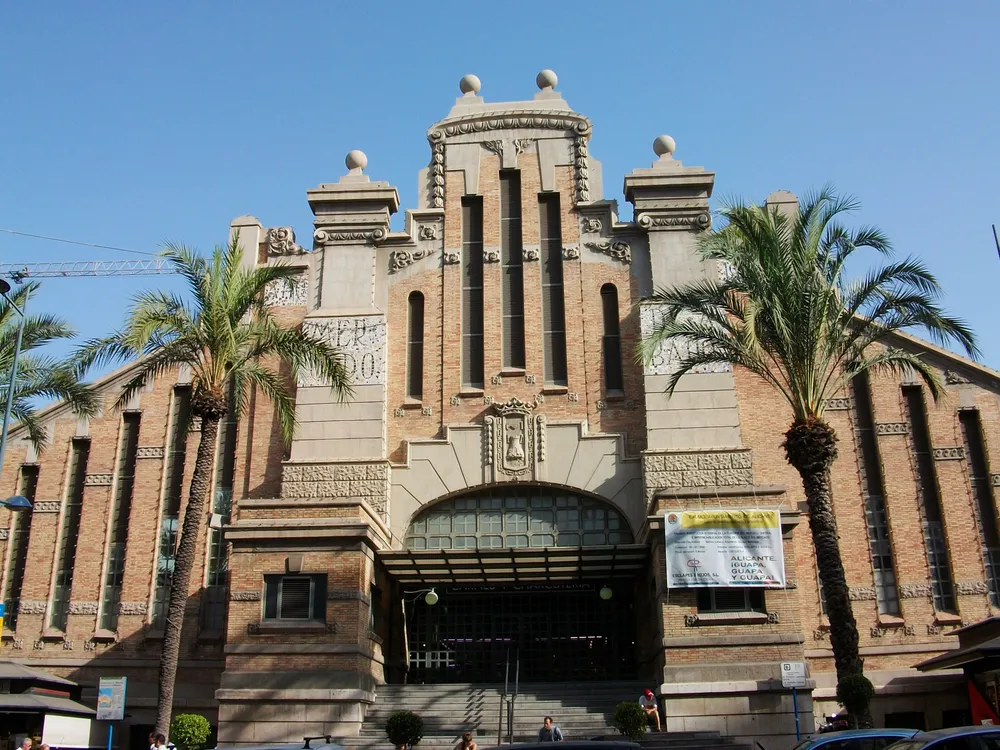
Modernist market of 11,000 m² designed in 1915 and completed in 1921 with an exposed brick façade. Its characteristic rotunda features a hemispherical dome decorated with coloured ceramic tiles.
The Mercado Central de Alicante occupies an eclectic building with Valencian modernist ornamentation, standing where several avenues meet in the city centre. Its story starts in 1911, when architect Enrique Sánchez Sedeño drew up the first plan to replace the old food market on the site. The design was revised in 1914 by engineer Próspero Lafarga and architect Francisco Fajardo Guardiola, and the final construction, carried out under Juan Vidal between 1917 and 1921, produced the building that still stands today. The market opened for trade on 23 November 1921 and was formally inaugurated the following year.
The façade mixes a carpanel arch over the entrance, exposed brick and coloured tile, and details borrowed from Castilian architecture such as Herrerian-style pinnacles — a combination typical of Alicante's eclectic taste in the early 20th century. Inside, a large roof lets Mediterranean light flood a trading floor of roughly 11,000 square metres, arranged around a central rotunda topped by a semi-spherical dome finished in coloured ceramic tile, the building's most photographed feature.
Still a working market
Unlike some of the city's other modernist buildings, which have been converted into museums or exhibition halls, the Mercado Central still works as a food market, with fish, meat, fruit and vegetable stalls spread across the floor. Walking its aisles is a way to see Alicante's everyday life, away from the more touristy circuit. It's a short walk from the centre of Alicante, the modernist façade of Casa Carbonell and the Teatre Principal, which makes it easy to combine with a walk through the Barrio de Santa Cruz without needing transport.
Frequently asked questions
Is the Mercado Central free to enter?
Yes, walking through the market costs nothing — you only pay for what you buy from the stalls.
When's the best time to visit?
Weekday mornings are when the market is busiest and the stalls are best stocked; by the end of the day some vendors start packing up.
Can you eat there?
Yes, alongside the food stalls there are counters and small bars where you can get something to eat while walking around.
Comments
Sign in with Google to comment and rate
Be the first to comment.