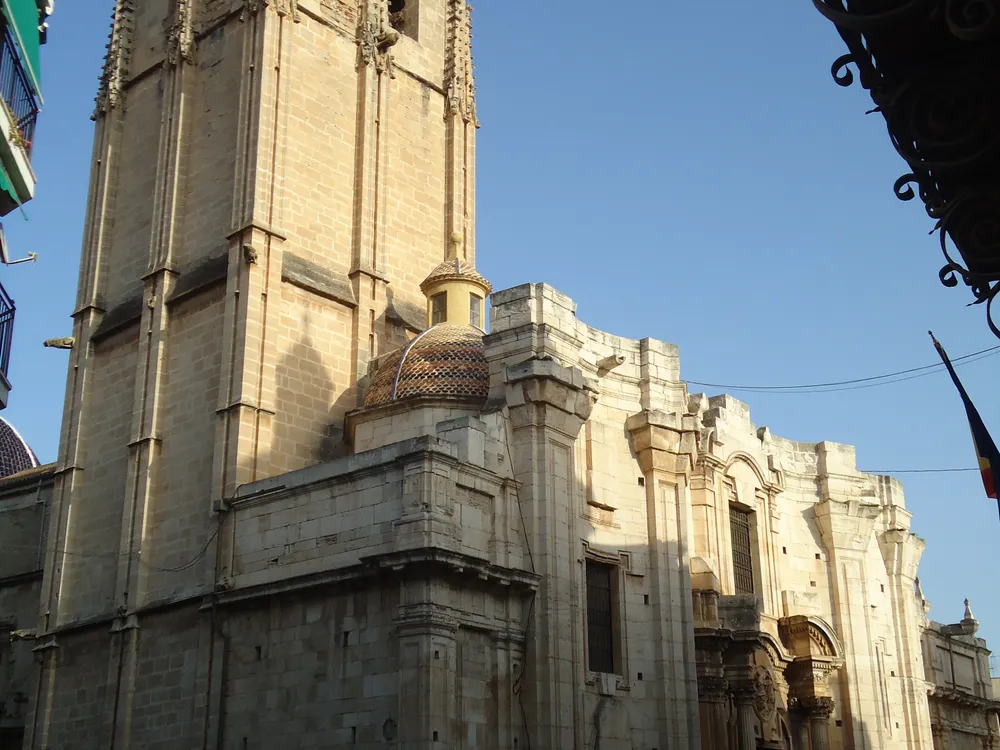
Iglesia Parroquial de Santas Justa y Rufina
Fourteenth-century Gothic temple renewed in Renaissance and Baroque periods. Its bell tower dominates the old town; inside rests the relic of the Lignum Crucis and Renaissance works. The church honours two martyred sisters, patrons of Orihuela.
The parish church of Santas Justa y Rufina stands on the site of a former mosque and is dedicated to Orihuela's two patron saints. It was built in Gothic style in the 14th century, with later reforms in the 16th and 18th centuries adding Renaissance and Baroque elements to the original structure.
The city's patron saints
According to tradition, the feast day of Justa and Rufina coincides with the date the city passed into Christian hands, 17 July 1243, which explains the special bond between the two saints and Orihuela. The single-nave, unusually tall church combines the original Catalan Gothic with later additions, and is notable for its Gothic bell tower, decorated with gargoyles and holding one of the oldest working clocks in Spain. The Renaissance Puerta del Evangelio (Gospel doorway) is another of the building's most valued features.
Inside, the church keeps the Lignum Crucis, a work by Alberto Martínez from 1573, along with a 15th–16th-century image of the Virgen del Rosario, or de Gracia, held in the Chapel of the Communion. Both pieces rank among the city's most valuable religious heritage.
The church stands in the heart of Orihuela's historic centre, close to the cathedral and the Convento de Santo Domingo, and a short walk from the Casa-Museo de Miguel Hernández, making it a natural stop on any walk through the old town.
Frequently asked questions
Is it free to visit?
Yes, there's no charge to go inside.
Why are Justa and Rufina important to Orihuela?
They're the city's patron saints; tradition holds that their feast day coincides with Orihuela's Christian reconquest in 1243.
What's the standout piece inside?
The 1573 Lignum Crucis, one of the most valuable relics kept in the city.
Comments
Sign in with Google to comment and rate
Be the first to comment.