What to see in Orihuela
Orihuela lies on the plain of the Segura river, in the southwestern corner of Alicante province, where irrigated farmland meets the sierra that shares its name. Built in golden-hued stone and wedged between the Monte de San Miguel and the riverbed, the old town holds centuries of religious and civil architecture that earned it protected historic-ensemble status in 1969, one of the first such designations in Spain. Unlike other towns in the province, Orihuela's character is tied to the valley and its market gardens rather than to the Mediterranean.
Layers of history
The city sits on a crossroads once guarded by Visigothic and later Andalusi rulers from the Castillo-Alcazaba, perched 240 metres up on the Monte de San Miguel. After the 13th-century Christian conquest, the old main mosque became the Catedral del Salvador y Santa María, its three Gothic naves and carved doorways spanning the 13th and 14th centuries. A Dominican college founded a century later grew into a pontifical university by 1569, known today as the Convento-Colegio Santo Domingo, its cloisters mixing Gothic, Renaissance and Baroque work. Nearby, the Iglesia de Santas Justa y Rufina keeps a gargoyled Gothic bell tower with one of the oldest clocks in the country, above an interior that blends Catalan Gothic with later Renaissance and Baroque additions; the feast day of its two patron saints coincides, by local tradition, with the date of the town's Christian reconquest on 17 July 1243.
The huerta and the poet
North of the centre, the Palmeral de San Antón — the second-largest palm grove in Europe after the one in Elche — still runs on irrigation channels dug by the town's Muslim settlers, a system that continues to shape the surrounding market-garden landscape; some of its palms are more than 300 years old, and the grove forms part of the EU's Natura 2000 network of protected sites. That same landscape of orchard plots and palms shaped the childhood of poet Miguel Hernández, whose family home, now the Casa-Museo de Miguel Hernández since it opened to the public in 1985, preserves his bedroom and the fig tree in the courtyard that appears in his early poems, written before he left for Madrid in the 1930s. The huerta reaches all the way to the coast: the municipality holds 18 kilometres of shoreline next to Torrevieja, pairing a monumental interior with a Mediterranean fringe within a single town boundary, a combination few other places in the province can match.
🚆 How to get there from Alicante
Orihuela sits around 60 kilometres southwest of Alicante, a drive of 35 to 45 minutes on the AP-7 motorway or the A-7. It's one of the best rail-connected towns in the province: the Orihuela-Miguel Hernández station sits on the C-1 commuter line, which links Alicante and Murcia with frequent departures throughout the day. Regular intercity buses from Alicante's bus station also serve the town. Whichever option you choose, the trip is short enough to combine comfortably with a day trip from the coast.
- By car, via the AP-7/A-7 to the Orihuela exit.
- By commuter train, C-1 line Alicante-Murcia, with a stop in the town centre.
- By intercity bus, with direct connections several times a day.
Compare all towns by transport →
-
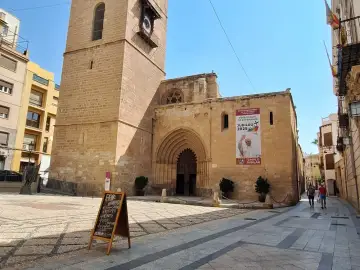 Church · FREECatedral del Salvador y Santa MaríaOrihuela — Vega Baja del Segura (Alacant)
Seat of the Orihuela-Alicante diocese, begun in the thirteenth century on remains of an Islamic mosque.
-
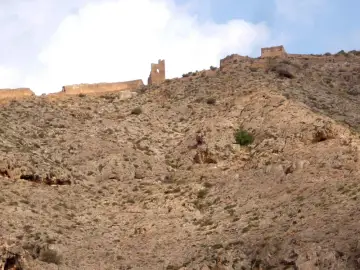 CastleCastillo-Alcazaba de OrihuelaOrihuela — Vega Baja del Segura (Alacant)
Medieval fortress on the mountain of San Miguel, dating back before the Caliphate and modified over centuries until its destruction in…
-
 ChurchConvento-Colegio Santo DomingoOrihuela — Vega Baja del Segura (Alacant)
Dominican monastery and university built from 1553, nicknamed 'The Escorial of Levante'.
-
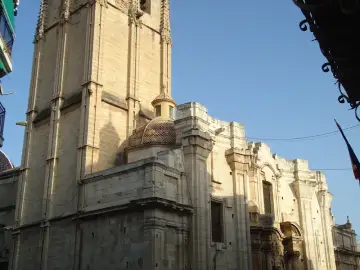 Church · FREEIglesia Parroquial de Santas Justa y RufinaOrihuela — Vega Baja del Segura (Alacant)
Fourteenth-century Gothic temple renewed in Renaissance and Baroque periods.
-
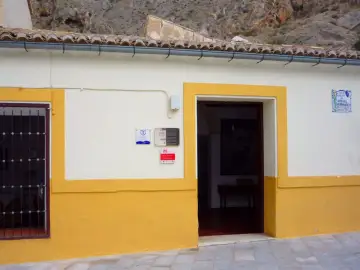 MuseumCasa-Museo de Miguel HernándezOrihuela — Vega Baja del Segura (Alacant)
Birthplace and childhood home of the 20th-century poet, kept as a house-museum from 1914 to 1934.
🏖️ Beaches
- 🌿Beach & nature · FREEPlaya de La Zenia (Orihuela Costa)Orihuela
A sandy cove sheltered by a cliff in Orihuela Costa, with water that's calm almost year-round and much of the resort's life — from the…
- 🌿Beach & nature · FREECala Capitán (Cabo Roig)Orihuela
A small cove by the Cabo Roig marina, split in two by a tiny islet and sheltered by rocky headlands on both sides: calm water, a semi-urban…
Frequently asked questions
Is it free to visit Orihuela Cathedral?
No — the combined ticket for the cathedral and its diocesan museum has a cost, though the diocese opens both for free on a handful of set dates each year.
How much time do you need to see Orihuela?
Half a day covers the old town's main monuments on foot. Add a full day if you also want an unhurried walk through the Palmeral de San Antón or the climb up to the Castillo-Alcazaba.
Is Orihuela good for visiting with children?
The historic centre is flat and easy to walk with kids, and the Palmeral offers shaded, level paths. The climb up to the Castillo-Alcazaba is steep, so it's worth weighing against the children's age.