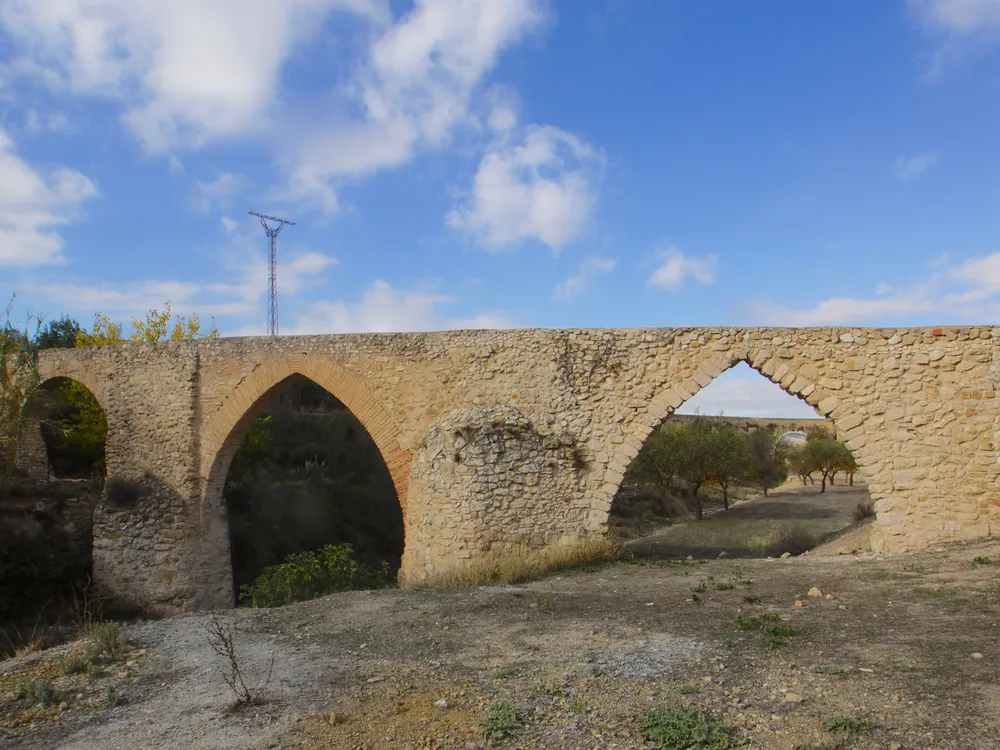
Acueducto Medieval
70-meter structure built in 1490 to manage irrigation water and prevent flooding. An example of medieval hydraulic engineering preserved in Biar's landscape.
The medieval aqueduct that survives in Biar crosses the Rambla dels Molins on three stone arches, a piece of hydraulic engineering built in 1490 to carry irrigation water to the fields on the far bank and, in doing so, keep flash floods from washing away the crops. It runs about 70 metres and is attributed to the architect Pere Compte, born in Girona and active in those same years on two of the great Gothic works of the Comunitat Valenciana: the Llotja de la Seda and its cathedral.
Construction
The structure combines stone with fired clay brick and rests on piers and buttresses designed to withstand the force of floodwater. It bridges the drop in level with three arches: two pointed, in the Gothic tradition, and one rounded. The ravine it crosses stays dry most of the year and only runs with force after heavy rain, a pattern typical of watercourses across the inland province. That mix of pointed and round arches in a single structure, unusual for the period, is what gives it its popular name, the "ogival aqueduct."
Today
The aqueduct is listed as a local heritage asset and forms part of the Camino del Cid tourist route, which links sites associated with the legend of Rodrigo Díaz de Vivar across the inland province. It can be seen from the flat ground below the castle, forming one of Biar's more recognisable views, and sits a short walk from the Iglesia de la Asunción and the town centre. The surrounding ground is flat and easy to reach, unlike the climb to the castle, which makes it a short stop as part of day trips from Alicante into the inland province.
Frequently asked questions
Is the medieval aqueduct in Biar free to see?
Yes, it is an open-air structure with free access at any time.
How long does it take to visit?
Around ten to fifteen minutes is enough to see it and photograph it with the castle in the background.
Is it suitable for the whole family?
Yes, the surrounding ground is flat and easy to walk, unlike the climb to the castle, so it works well even with young children or limited mobility.
Comments
Sign in with Google to comment and rate
Be the first to comment.