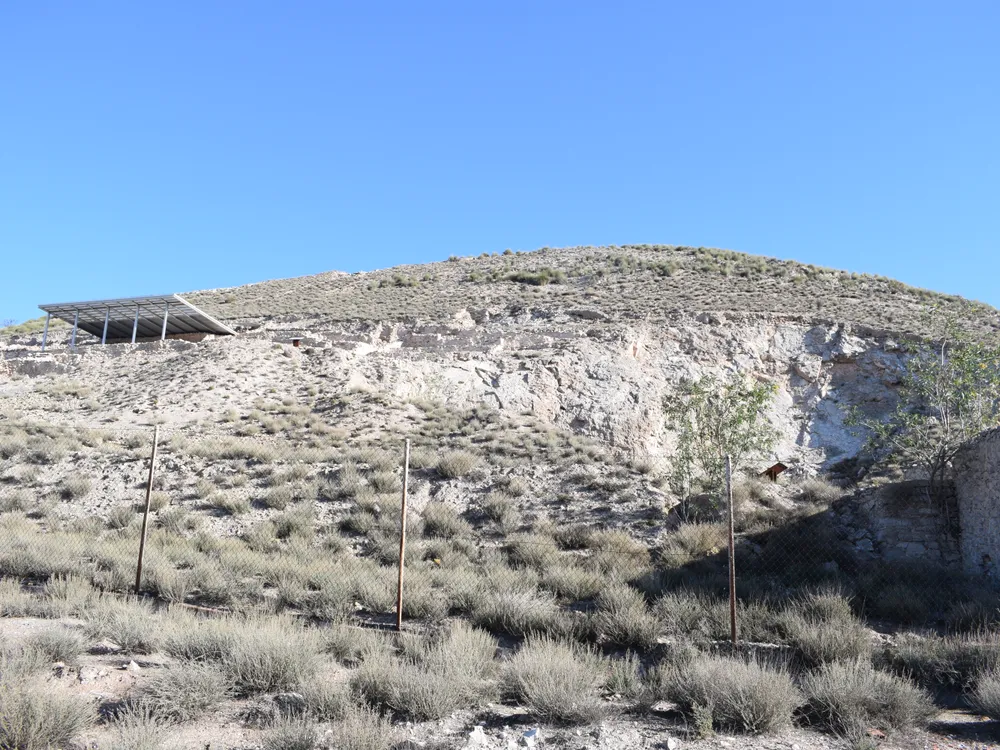
Yacimiento de Cabezo Redondo
Bronze Age settlement (1500–1100 BC) with evidence of early urbanism on the Iberian Peninsula. A vertical loom from 3,500 years ago was found in excellent condition.
Cabezo Redondo is a Bronze Age site on the outskirts of Villena, occupied roughly between 1500 and 1100 BC. It marks the frontier between the Argaric culture and what is known as the Valencian Bronze Age, and is considered one of the most significant settlements of that period anywhere in the western Mediterranean.
One of the peninsula’s earliest planned towns
Toward the end of its occupation, the settlement grew into an urban centre of almost a hectare, with blocks of rectangular houses built on artificial terraces and separated by narrow streets. Researchers regard this layout as the earliest evidence of planned urbanism on the Iberian Peninsula, with medium and large houses and areas set aside for craft production.
The site itself was first excavated in the 1970s and continues to be the subject of periodic digs, which have gradually expanded the known area of the settlement beyond its original core.
The most recent and scientifically significant find is a vertical loom about 3,500 years old, discovered beneath the remains of a roof that collapsed in a fire which destroyed part of the settlement. Charred wooden beams, clay weights and esparto-grass cords survived, a combination that has let a University of Alicante team study Bronze Age textile techniques in unusual detail; the research was published in the journal Antiquity.
The site is visited outdoors and free of charge, another of the province’s free things to do inland, though most of the pieces found there, including the loom, are studied and displayed at the Museo Arqueológico José María Soler in central Villena. It combines well with a visit to the Castillo de la Atalaya to round out a tour of the town’s different historical periods.
Frequently asked questions
Is Cabezo Redondo free to visit?
Yes, the outdoor site is open and free to access.
Can you see the loom found at the site?
The loom remains are studied and displayed at the Museo Arqueológico José María Soler in central Villena, not at the site itself.
Why is this site significant?
It holds the earliest known evidence of planned urbanism, with streets and blocks of houses, on the Iberian Peninsula.
Comments
Sign in with Google to comment and rate
Be the first to comment.