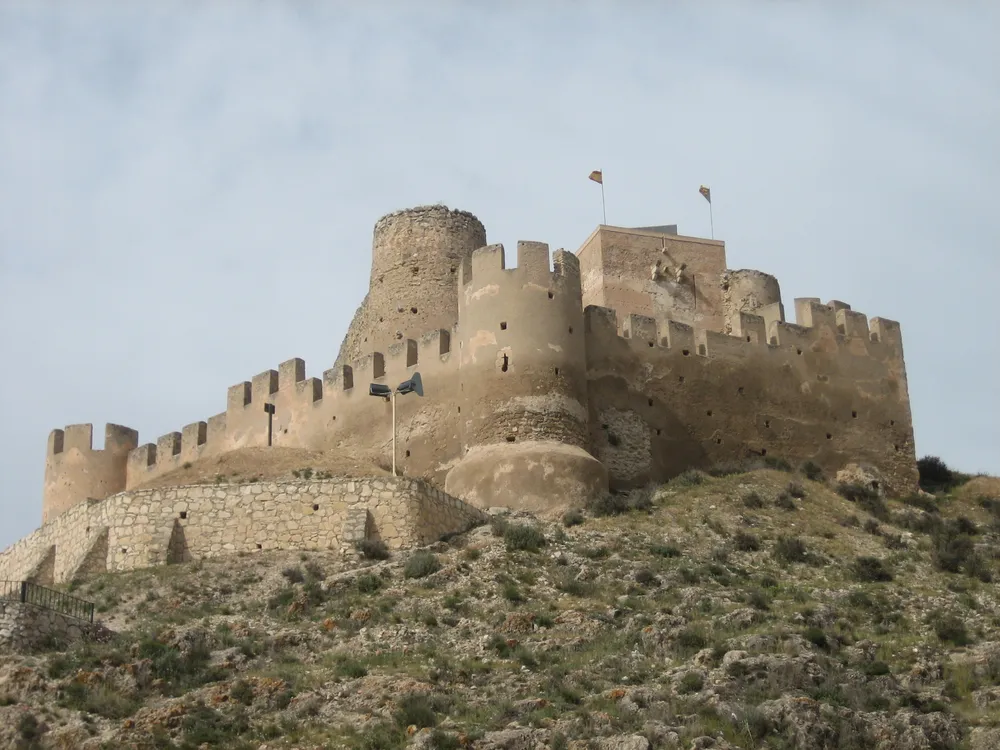
Castillo de Biar
Medieval fortress of Muslim origin located at 750 meters elevation. Its 19-meter Almohad tower and defensive walls with four external circular towers dominate the valley from a strategic position.
The Castillo de Biar sits on a rocky outcrop 750 metres above sea level, above the town of Biar, at the point where the Alt Vinalopó comarca meets the edge of the Castilian plateau. Its origins date to the mid-12th century, when the area lay within al-Andalus, and its position allowed it to watch over the natural route between the interior of the peninsula and the coastal lands of Alicante. The complex was declared a national monument in 1931.
Keep and walls
The most recognisable structure is the square-plan keep, around 19 metres tall and built in masonry and rammed earth. Inside, it preserves a ribbed vault of Almohad origin, thought to be among the oldest of its kind still standing in Spain; the Castillo de Villena, not far away, holds a comparable example. A double line of walls surrounds the keep, with four towers on the outer face and three more inside, added during later Christian-era enlargements that followed the 13th-century conquest.
Visiting and the views
The climb starts on foot from the old town, passing the Iglesia de la Asunción, whose bell tower sits lower on the hillside than the castle itself. From the top of the walls, the view opens over the Vinalopó valley, with the medieval aqueduct visible on the flat ground below. The path has some steep stretches, so sturdy footwear helps, and the middle of the day in summer is not the most comfortable time to climb.
The castle is one stop on the Ruta de los Castillos del Vinalopó, a route linking the fortresses of Villena with others in the comarca and tracing the defensive line that once separated the kingdoms of Castile and Aragón for centuries.
Frequently asked questions
Is the Castillo de Biar free to visit?
No, entry to the walled compound is ticketed; walking up to the hill and around the outside is free.
How long does a visit take?
Including the walk up from the town and a look around the walls and keep, most visits take around an hour to an hour and a half.
When is the best time to climb up?
Spring and autumn bring milder temperatures for the climb; in summer it is worth avoiding the middle of the day, since the path offers little shade.
Comments
Sign in with Google to comment and rate
Be the first to comment.