
What to see in Villena
Villena occupies the northwestern tip of Alicante province, in the Alto Vinalopó district, on a natural corridor between the inland plateau and the Mediterranean where archaeological finds trace human presence back some 50,000 years. On a hill above the plain stands the Castillo de la Atalaya, built by the Almohads in the 12th century and extended two centuries later by Juan Pacheco, second Marquis of Villena, who added the keep's upper two floors. The result is a polygonal fortress with towers at its angles and a four-storey keep — its lower two levels Andalusi, roofed with interlocking-arch vaults that share their technique with the nearby castle at Biar — with walls over three metres thick rising to 25 metres.
Frontier and sieges
Villena's position on the frontier for much of the Middle Ages meant the castle changed hands repeatedly and saw combat again centuries after it was built. During the Germanías revolt it sheltered a viceroy; in the War of the Spanish Succession it withstood a week-long siege in April 1707 that left artillery scars still visible on its walls; and in the Peninsular War, Marshal Suchet's troops blew up part of the keep in 1813. The town's loyalty during the 1707 siege earned it the royal title 'Muy Noble y Muy Leal' (Very Noble and Very Loyal) from Felipe V. Its vaults still carry graffiti and engraved rosettes scratched by prisoners from those conflicts, alongside older Muslim- and Christian-era graffiti. The Museo Festero, set in a 19th-century mansion, holds the costumes and archives of the fourteen comparsas that take part in the city's Moors and Christians festival each year.
Three thousand years before the castle
Two kilometres outside town, the Cabezo Redondo site preserves a Bronze Age settlement roughly 3,500 years old, its blocks of houses lined up along alleys in one of the earliest examples of planned urban layout on the Iberian Peninsula. Its inhabitants were probably connected to the town's most famous find: the Tesoro de Villena, a hoard of gold and silver bowls, bracelets and bottles from around 1000 BC, found by chance in 1963 by the archaeologist José María Soler, whom the museum is named after, and now on display at the Museo Arqueológico José María Soler. At ten kilograms of gold, it ranks among the most important Bronze Age goldsmithing collections in Europe, comparable to the grave goods from the royal tombs at Mycenae.
🚆 How to get there from Alicante
Villena is around 58 kilometres northwest of Alicante, roughly 45 to 50 minutes by car on the A-31 motorway, which runs directly between the two. The town has two separate railway stations: a conventional one near the centre, on the line linking Alicante and Madrid, and a high-speed one on the outskirts, on the Madrid-Levante line, best reached by car or taxi since it has no public transport link of its own.
- By car, on the A-31 motorway to Villena.
- By train, stopping at either the conventional or the high-speed station.
- By intercity bus, with regular departures from Alicante's bus station.
Compare all towns by transport →
-
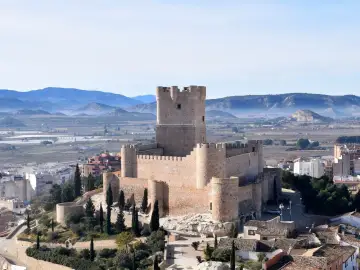 CastleCastillo de la AtalayaVillena — Alt Vinalopó (Alacant)
12th-century fortress built by the Almohads as a refuge for the Muslim population.
-
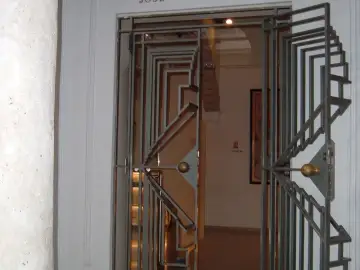 MuseumMuseo Arqueológico José María SolerVillena — Alt Vinalopó (Alacant)
Holds Iberian and Roman objects, with emphasis on the Villena Treasure: pieces of gold, silver, iron, and amber of incalculable value.
-
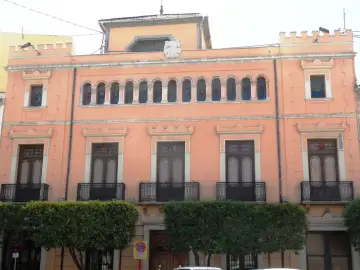 MuseumMuseo FesteroVillena — Alt Vinalopó (Alacant)
Displays items related to Villena's Fiesta de Moros y Cristianos, one of the region's most important celebrations.
-
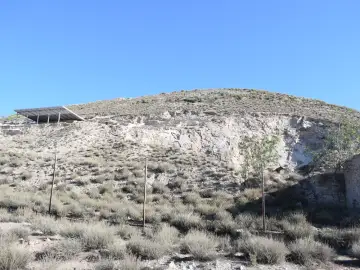 Monument · FREEYacimiento de Cabezo RedondoVillena — Alt Vinalopó (Alacant)
Bronze Age settlement (1500–1100 BC) with evidence of early urbanism on the Iberian Peninsula.
Frequently asked questions
Is it free to visit the Castillo de la Atalaya?
No, admission has a small charge and includes a guided tour; young children get in free.
How much time do you need in Villena?
Half a day is enough for the castle, the archaeological museum and the historic centre. Adding the Cabezo Redondo site or the Museo Festero makes a full day worthwhile.
Is Villena worth a day trip from Alicante?
Yes — it's a short run on the motorway to a medieval castle, a museum holding a Bronze Age gold hoard, and a little-visited archaeological site, a combination that's unusual to find in a single inland town.