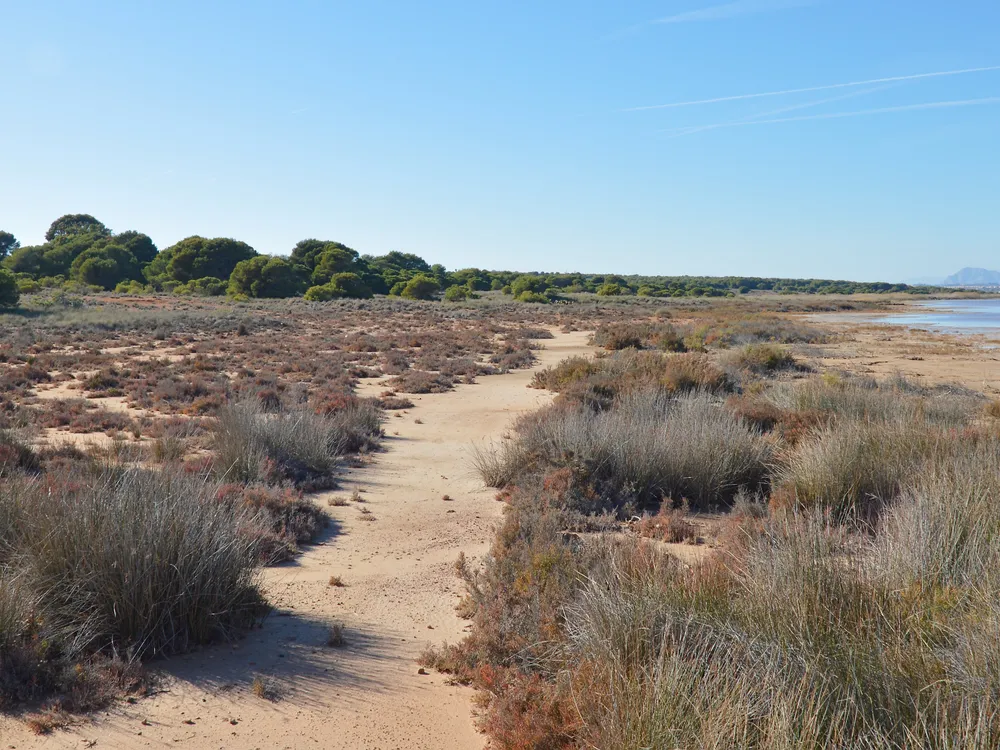
Parque Natural de las Lagunas de La Mata y Torrevieja (Laguna Rosa)
Protected wetland of 3,700 hectares spread across four municipalities. The Torrevieja lagoon, some 1,400 hectares, takes its pink colour from hallobacteria and microscopic algae producing red pigments. There are viewpoints and marked paths around the water.
The Parque Natural de las Lagunas de La Mata y Torrevieja protects a wetland of around 3,700 hectares spread across four municipalities in the Vega Baja district, with more than 2,100 hectares of open water. Inside it sit two lagoons of very different character: La Mata, greenish in tone, and the Torrevieja lagoon, roughly 1,400 hectares and pink, the one that has made the park internationally known.
Why the water turns pink
The pink colour comes from microscopic organisms that only thrive in very salty water: the microalga Dunaliella salina and several species of halobacteria, which produce carotenoid pigments to protect themselves from sunlight. Salinity in the lagoon can exceed 300 grams per litre, several times that of the Mediterranean and comparable to the Dead Sea. That same water feeds the flamingos regularly seen along the shore, whose pink colour comes largely from what they eat here.
A landscape that is still industrial
Despite its resort-like appearance, the Torrevieja lagoon has hosted an active salt operation for centuries, today run by a company that extracts several hundred thousand tonnes of salt a year. That is why swimming is banned: besides being a protected area, submerged machinery works in parts of the lake, making it genuinely dangerous to enter the water, with fines for anyone who tries.
The park is free to enter, with several signposted viewpoints and trails that circle the water without approaching the working areas. It pairs well with the Dique de Levante or the Museo del Mar y de la Sal, which explains the city's salt history in more depth. The pink colour is usually most intense in summer, when evaporation concentrates the salt and, with it, the organisms that tint the water.
Frequently asked questions
Can you swim in the pink lagoon?
No, swimming is banned for safety and conservation reasons; salt is still extracted using submerged machinery.
Why is the water pink?
Because of microorganisms that only survive in very salty water, mainly the microalga Dunaliella salina and several halobacteria, which produce pigments to protect themselves from the sun.
When is the colour most intense?
Usually in summer, when evaporation raises the salt concentration and, with it, the activity of the organisms that tint the water.
Comments
Sign in with Google to comment and rate
Be the first to comment.