What to see in Callosa d'en Sarrià
Callosa d'en Sarrià sits on a plain watered by the Algar and Guadalest rivers, closed in by the Aitana, Bernia and Aixortà mountain ranges, about ten kilometres from the Marina Baixa coast. Its population of just over 8,000 depends heavily on growing loquats, the fruit that has made the town's name known well beyond Alicante, though Callosa's origins go back much further than that crop: it began as an Arab farmstead and still carries, in its own name, the trace of the feudal lords who ruled it after the Christian conquest.
From Arab farmstead to loquat country
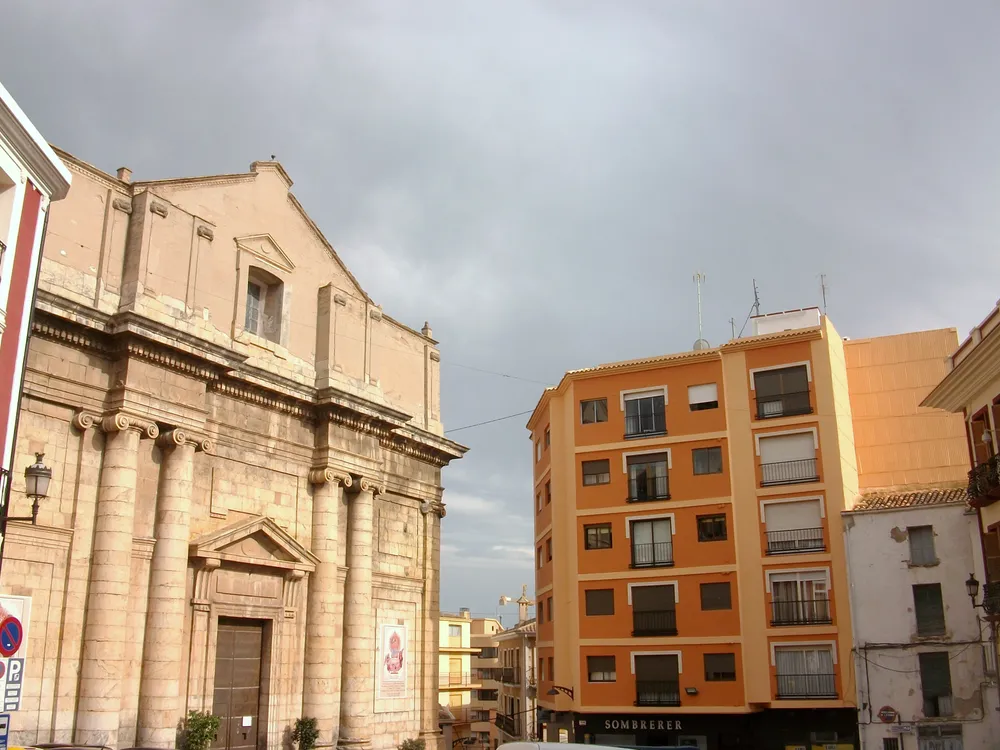
After Jaume I's thirteenth-century conquest, the admiral Bernat de Sarrià acquired the lordship in 1290, and his surname has stayed attached to the town's name ever since. Other noble houses followed, among them the Corona de Aragón, Bou and Moncada families and the Count of Orgaz, who held the lordship until the eighteenth century. The Iglesia Arciprestal de San Juan Bautista, built in 1578 and remodelled in 1765 by the architect Antoni Gilabert Fornés, still holds a baroque organ from 1754 and is the most important religious building in the town centre. The loquat arrived much later: it was introduced in the nineteenth century by the local grower Juan Bautista Berenguer y Ronda, and the first cooperatives to sell the fruit formed after the Spanish Civil War, with the local agricultural cooperative founded in 1958. Since 1992 Callosa's loquats have carried a Denominación de Origen Protegida, a designation that covers nineteen municipalities across the Marina Baixa and Camp d'Alacant and under which the town accounts for roughly half of all Spanish production, most of it exported to France and Italy.
The Fuentes del Algar and the rest of the town
Three kilometres from the centre, the Fuentes del Algar form a protected wetland where water from an aquifer in the Bernia and El Ferrer mountains drops through waterfalls and natural pools along a walkway a little over a kilometre long, fitted with boardwalks and viewing points. That same watercourse, the Río Algar, rises further up near Tàrbena and takes in the Guadalest, its main tributary, before reaching the Mediterranean at Altea. In the town centre, the Museo Etnológico y Arqueológico holds objects donated by residents, recreates an old village schoolroom and documents the area's traditional trades. Anyone planning a full day out can pair Callosa with Guadalest, about twelve kilometres up the CV-70, in the same river valley.
🚆 How to get there from Alicante
Callosa d'en Sarrià lies inland in the Marina Baixa comarca, around 45-50 kilometres from the city of Alicante. The town has no train station, but Alicante's metropolitan TRAM line runs as far as Benidorm, from where a bus or taxi covers the rest of the way into the centre.
- By car, take the AP-7 motorway or the N-332 to Benidorm, then the CV-70; the drive takes roughly 40-50 minutes from the city of Alicante.
- By bus, direct services run from Alicante's bus station into the centre of Callosa.
- From the coast, regional buses connect Callosa with Benidorm, La Nucía and neighbouring Polop, making it easy to combine several Marina Baixa towns in one route.
Compare all towns by transport →
-
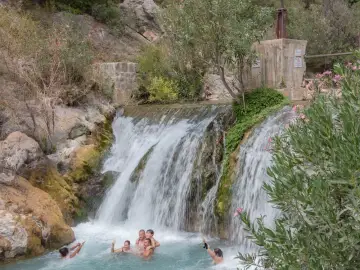 Beach & natureFuentes del AlgarCallosa d'en Sarrià — Marina Baixa (Alacant)
Ensemble of waterfalls, pools, and springs along the Algar river spanning 1.5 kilometers through limestone karst formations.
-
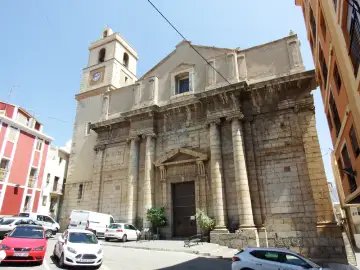 Church · FREEIglesia Arciprestal de San Juan BautistaCallosa d'en Sarrià — Marina Baixa (Alacant)
Archpriest church in the old town with a valuable Baroque organ from 1754.
- 🏛️MuseumMuseo Etnológico y ArqueológicoCallosa d'en Sarrià — Marina Baixa (Alacant)
The first ethnology and archaeology museum in Marina Baixa, displaying objects from traditional life from the early 20th century.
- 🌿Beach & nature · FREERío AlgarCallosa d'en Sarrià — Marina Baixa (Alacant)
River of crystalline waters that flows through Callosa and feeds the Fuentes del Algar.
Frequently asked questions
Is entry to the Fuentes del Algar free?
No, the natural site charges an entry fee year-round. There is a free parking area a short walk from the entrance, as well as paid parking closer to the main gate.
When is the best time of year to visit the Fuentes del Algar?
Spring and autumn offer the best balance of good weather and smaller crowds. Summer draws the largest crowds even though the water stays cool all year, while winter can bring colder water and, after rain, a stronger flow.
Can Callosa d'en Sarrià be visited as a day trip from Alicante?
Yes. It's under an hour's drive from the city of Alicante, close enough to combine the walk through the Fuentes del Algar with the historic centre and, if time allows, a stop in nearby Guadalest.