What to see in Xixona
Jijona sits in a mountain valley 28 kilometres from Alicante, between the Penya Migjorn ridge and the Puerto de la Carrasqueta pass, the route that has linked the coast with the interior for centuries. The old town keeps a maze of steep, narrow streets that follow the shape of the hill, a layout inherited from Muslim-era Jijona — recorded as far back as Visigothic times, when it was named in connection with the founding of the Denia bishopric, and known as Uxonig under Andalusi rule — before Jaume I brought the town into the Christian conquest in the 13th century. Felipe V granted it city status in 1708, after a turbulent stretch in which the town was besieged in 1706 and retaken the following year.
From the hilltop to turrón
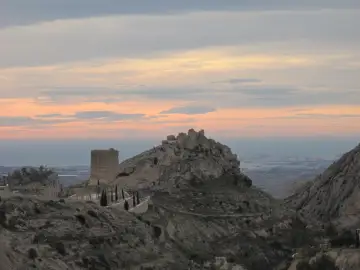
Above the town stands the Castillo de la Torre Grossa, built by the Almohads between the late 12th and early 13th centuries and extended after the Christian conquest, when it became part of the defensive line along the region's southern frontier; the tower and stretches of its surrounding wall still stand today. The Iglesia de Nuestra Señora de la Asunción went up under Christian rule between the 16th and 17th centuries, in the plain, late-Gothic style typical of the area. Tradition credits Arab and Jewish settlers with introducing the almonds that, centuries later, gave rise to turrón: the earliest known document mentioning the sweet dates to 1484, though it was likely made by hand well before that.
Turrón and ice cream
Jijona still accounts for a large share of Spain's turrón production, with several of the sector's historic brands based in the town, and the Museo del Turrón walks visitors through the entire process, from almond to finished bar. Less well known is that Jijona's turrón makers were already producing ice cream in the 16th century, using snow wells cut into the surrounding sierra to keep it through summer, when demand for turrón — an almost exclusively winter sweet — dropped to nothing; today the town has the largest number of registered artisan ice cream makers anywhere in Spain. The Forn del Raval de la Peñita, a wood-fired oven with Moorish roots documented since the 16th century, still operates in the old town as a working link to that craft. The same mountain pass connects Jijona with Alcoy, the other major inland industrial town, barely half an hour away by road.
🚆 How to get there from Alicante
Jijona is about 28 kilometres from Alicante, a short drive of just over half an hour on the CV-70 or the older N-340 road into the interior. The town has no railway station, so the choice is between a private car and the intercity bus, which runs several times a day to Alicante's bus station and takes around an hour, somewhat slower than driving because of intermediate stops. Either way, the short distance makes Jijona an easy addition to a longer stay on the coast.
- By car, on the CV-70 toward Jijona/Alcoy.
- By direct intercity bus from Alicante's bus station.
- Combined with a visit to Alcoy, since both towns share the same mountain pass.
Compare all towns by transport →
-
 CastleCastillo de la Torre GrossaXixona — L'Alacantí (Alacant)
12th-century fortress of Almohad origin located at 570 meters elevation.
- 🏛️MuseumMuseo del TurrónXixona — L'Alacantí (Alacant)
Institution dedicated to the technological heritage of turrón production.
- ⛪Church · FREEIglesia de Nuestra Señora de la AsunciónXixona — L'Alacantí (Alacant)
Renaissance temple from the late 16th century with a stone bell tower topped by a roof of white and green tiles.
- 🗿Monument · FREEForn del Raval de la PeñitaXixona — L'Alacantí (Alacant)
Traditional wood-fired oven with Moorish roots documented from the 16th century, possibly originating in the 15th.
Frequently asked questions
Is the Museo del Turrón free to visit?
No, admission has a small charge, though it includes a turrón tasting at the end of the tour.
Is Jijona a good day trip from Alicante?
Yes, it's one of the closest inland towns to the coast, and its old town, castle and turrón-related sites fit comfortably into half a day without needing to stay overnight.
When is the best time to visit Jijona?
December is the busiest season, with turrón production running at full pace before Christmas, though the old town and castle are worth visiting at any time of year.