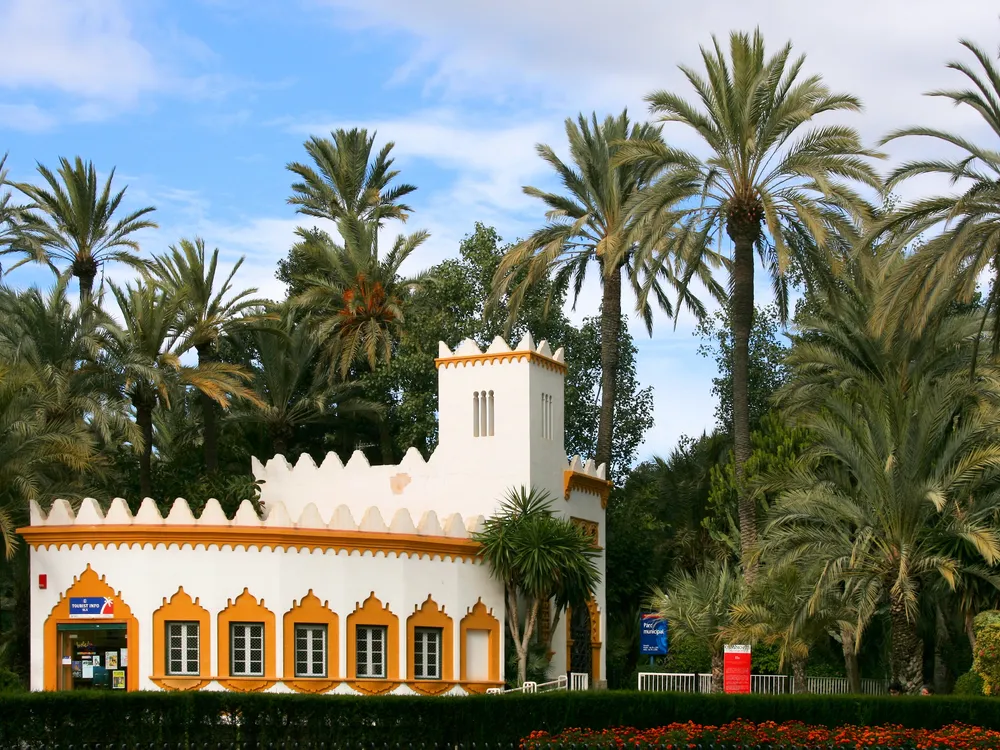
Palmeral de Elche
This system of 200,000 date palms, planted since Roman times, is a UNESCO World Heritage Site. It covers 144 hectares of ancient Islamic and medieval orchards, which are central to the region's identity.
The Palmeral de Elche is the largest system of palm groves in Europe, with roots in Iberian and Roman-era irrigation, though its current layout of walled square plots dates from the 10th century, when the Caliphate of Córdoba organised the irrigation system after founding Islamic-era Elche. In 1265, following the Christian conquest, Jaume I stopped the palms from being cut down, since they were seen as a symbol of Islamic culture, a decision that goes a long way toward explaining their survival today.
Two scales, one landscape
In its broadest sense, the Palmeral covers around 500 hectares of the municipality of Elche, with as many as 300,000 date palms counted across urban orchards and outlying land. The core recognised by UNESCO as a World Heritage Site on 30 November 2000 is smaller: around 144 hectares of historic orchards within the city itself, holding close to 45,000 palms enclosed by stone walls or woven-leaf fencing. Some specimens are more than three hundred years old.
Walking the Palmeral
Walking through the orchards open to the public, several of them next to the Museo Arqueológico e Histórico de Elche, brings visitors close to the rows of palms and the traditional irrigation channels that still shape much of the city. Nearby, the Huerto del Cura holds the most carefully tended botanical variety in the whole system, while the Basílica de Santa María offers elevated views over the sea of palms that wraps around the historic centre. It is, by some distance, the largest of the region's gardens and parks.
Frequently asked questions
Is the Palmeral de Elche free to visit?
It depends on the area: walking the streets and open orchards of the historic centre is free, though some enclosed gardens, like the Huerto del Cura, charge admission.
When was it declared a World Heritage Site?
UNESCO declared it a World Heritage Site on 30 November 2000.
How long does it take to see?
One to two hours cover a walk through the historic orchards in the centre; anyone also visiting the Huerto del Cura or the archaeological museum should set aside half a day.
Comments
Sign in with Google to comment and rate
Be the first to comment.